八年级下册英语短语有哪些重点?
校园之窗 2025年12月15日 08:10:30 99ANYc3cd6
Unit 1 What's the matter?
本单元主要围绕“健康问题”和“建议”展开,是日常对话中的高频话题。
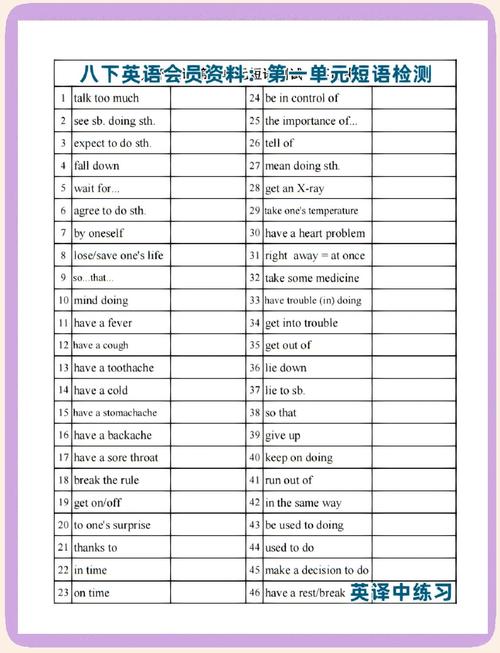
核心短语:
(图片来源网络,侵删)
- what's the matter? / what's wrong (with you)? 怎么了?(身体或某物出了什么问题)
- 例: What's the matter with your leg? 你的腿怎么了?
- have a fever 发烧
- 例: He has a fever, so he should stay in bed. 他发烧了,所以他应该卧床休息。
- have a cold 感冒
- 例: I think I have a cold. 我想我感冒了。
- have a cough 咳嗽
- 例: She has a bad cough. 她咳得很厉害。
- have a stomachache 胃痛;肚子痛
- 例: Eating too much ice cream will give you a stomachache. 吃太多冰淇淋会让你肚子痛。
- have a toothache 牙痛
- 例: I can't eat anything because I have a toothache. 我牙痛,什么也吃不了。
- have a sore back 背部酸痛
- 例: He lifted a heavy box and now he has a sore back. 他搬了一个重箱子,现在背很痛。
- have a sore throat 喉咙痛
- 例: I have a sore throat. I need to drink some hot tea. 我喉咙痛,需要喝点热茶。
- lie down and rest 躺下休息
- 例: The doctor told him to lie down and rest. 医生让他躺下休息。
- drink lots of water 多喝水
- 例: You should drink lots of water when you have a fever. 发烧时你应该多喝水。
- see a dentist 看牙医
- 例: I have a toothache. I need to see a dentist. 我牙痛,需要去看牙医。
- get an X-ray 拍X光片
- 例: The doctor asked him to get an X-ray to check his arm. 医生让他拍个X光片检查手臂。
- stress out 紧张;有压力
- 例: Exams always make me stress out. 考试总是让我很紧张。
- listen to soft music 听轻柔的音乐
- 例: Listening to soft music can help you relax. 听轻柔的音乐能帮助你放松。
- be stressed out 感到有压力 (形容词短语)
- 例: She is stressed out from work. 她因为工作而感到压力很大。
重点句型:
- You should/shouldn't + 动词原形... (你应该/不应该做某事)
- 例: You should see a doctor. 你应该去看医生。 You shouldn't eat so much candy. 你不应该吃这么多糖。
- Why don't you + 动词原形...? (你为什么不...呢?)
- 例: Why don't you lie down for a while? 你为什么不躺一会儿呢?
Unit 2 I'll help to clean up the city parks.
本单元主题是“志愿者活动”和“提供帮助”,学习如何用英语表达意愿和提供帮助。
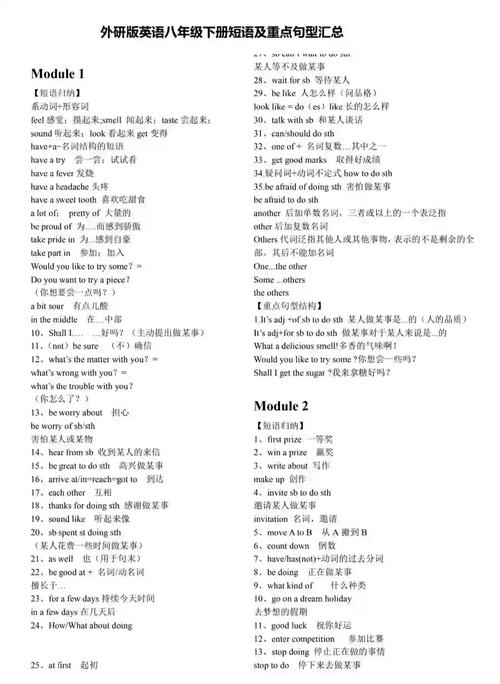
核心短语:
- clean up 打扫干净;清理
- 例: Let's clean up the classroom after school. 我们放学后打扫一下教室吧。
- clean out 清除...内部的东西
- 例: He cleaned out his desk and threw away old papers. 他清理了书桌,扔掉了旧纸。
- give out 分发;发放
- 例: Volunteers will give out food to the homeless people. 志愿者将向无家可归者分发食物。
- put off 推迟;延期
- 例: Don't put off your homework until tomorrow. 不要把作业推迟到明天。
- hand out 分发;发放 (与give out意思相近,更口语化)
- 例: Please help me hand out these books. 请帮我发这些书。
- call up 打电话给...
- 例: I'll call you up this evening. 我今晚给你打电话。
- set up 建立;设立
- 例: They set up a special fund to help the children. 他们设立了一个专项基金来帮助这些孩子。
- fix up 修理;装饰
- 例: He fixed up the old bike and gave it to his brother. 他修好了那辆旧自行车,并给了他弟弟。
- take after (在外貌、性格等方面) 与...相像
- 例: She takes after her mother; they both have blue eyes. 她长得像她妈妈,她们都有蓝眼睛。
- give away 赠送;分发 (通常指免费)
- 例: He gave away all his money to the poor. 他把所有的钱都给了穷人。
- run out of 用完;耗尽
- 例: We have run out of milk. 我们牛奶喝完了。
- be similar to 与...相似
- 例: Her new book is similar to her first one. 她的新书和第一本很相似。
- make a difference 有作用;有影响;起重要作用
- 例: Every little bit can make a difference. 每一份小小的努力都能起到作用。
- cheer up (使)变得更高兴;(使)振作起来
- 例: A good song can cheer you up. 一首好歌能让你振作起来。
- care for 照顾;非常喜欢
- 例: The nurses are caring for the sick nurses. 护士们正在照顾生病的护士。 / I don't care for modern music. 我不太喜欢现代音乐。
重点句型:
(图片来源网络,侵删)
- I'd like to + 动词原形... (我想做某事)
- 例: I'd like to help out the old people. 我想帮助老人。
- You could + 动词原形... (你可以做某事)
- 例: You could give out food at the food bank. 你可以在食物分发处分发食物。
- Because + 从句... (因为...)
- 例: He volunteers because he wants to help others. 他做志愿者是因为他想帮助别人。
Unit 3 Could you please clean your room?
本单元核心是“家务劳动”和“礼貌地提出请求或许可”,是家庭生活中的实用英语。
核心短语:
- do the chores 做家务
- 例: I have to do the chores after school. 我放学后必须做家务。
- do the dishes 洗碗碟
- 例: My mother is doing the dishes in the kitchen. 我妈妈正在厨房洗碗。
- sweep the floor 扫地
- 例: It's your turn to sweep the floor. 该你扫地了。
- take out the trash 倒垃圾
- 例: Could you please take out the trash? 你能去倒一下垃圾吗?
- make one's bed 整理床铺
- 例: My mom always makes me make my bed every morning. 我妈妈总是让我每天早上整理床铺。
- fold the clothes 叠衣服
- 例: Help me fold the clothes, please. 请帮我叠一下衣服。
- live with... 和...一起住
- 例: I live with my parents and my sister. 我和我的父母、妹妹一起住。
- get a ride 搭车
- 例: Can I get a ride to school with you? 我可以搭你的车去学校吗?
- work on 从事于;忙于
- 例: He is working on a new project. 他正忙于一个新项目。
- at least 至少
- 例: You should sleep for at least 8 hours a day. 你每天至少应该睡8个小时。
- pass me the salt 把盐递给我
- 例: Pass me the salt, please. 请把盐递给我。
- borrow...from... 从...借...
- 例: Can I borrow your pen? 我可以借你的笔吗?
- invite...to... 邀请...去...
- 例: He invited me to his birthday party. 他邀请我参加他的生日派对。
- accept an invitation 接受邀请
- 例: I'm happy to accept your invitation. 我很乐意接受你的邀请。
- refuse an invitation 拒绝邀请
- 例: I'm sorry, but I have to refuse your invitation. 很抱歉,我必须拒绝你的邀请。
- the opposite of... ...的反义词
- 例: The opposite of "love" is "hate". “爱”的反义词是“恨”。
重点句型:
- Could you please + 动词原形...? (你能不能...?)
- 例: Could you please take out the trash? 你能去倒垃圾吗?
- Could I + 动词原形...? (我可以...吗?)
- 例: Could I borrow your car tonight? 我今晚可以借用你的车吗?
- Why don't you + 动词原形...? (你为什么不...呢?)
- 例: Why don't you invite him to the party? 你为什么不邀请他参加派对呢?
- I have to + 动词原形... (我必须...)
- 例: I have to finish my homework first. 我必须先完成我的作业。
Unit 4 Why don't you talk to your parents?
本单元主题是“人际关系”和“提建议”,探讨与家人、朋友沟通中遇到的问题及解决方法。

(图片来源网络,侵删)
核心短语:
- argue with sb. 与...争吵
- 例: He often argues with his sister. 他经常和他妹妹争吵。
- instead of 代替;而不是
- 例: Let's play football instead of basketball. 我们踢足球而不是打篮球吧。
- communicate with sb. 与...交流
- 例: It's important to communicate with your parents. 和父母交流很重要。
- get on well with sb. 与...相处融洽
- 例: I get on well with my classmates. 我和同学们相处得很好。
- compete with sb. 与...竞争
- 例: Don't compete with others. Just try your best. 不要和别人竞争,尽力就好。
- have a hard time (in) doing sth. 做某事有困难
- 例: He had a hard time (in) making friends at first. 起初,他交朋友很困难。
- compare...to/with... 把...和...比较
- 例: Don't compare your child with others. 不要拿你的孩子和别人比较。
- pressure sb. to do sth. 强迫/迫使某人做某事
- 例: My parents pressure me to get good grades. 我父母逼我取得好成绩。
- focus on 集中精力于...
- 例: You should focus on your studies. 你应该集中精力学习。
- be strict with sb. 对某人严格
- 例: My parents are very strict with me. 我的父母对我很严格。
- in one's opinion 在某人看来
- 例: In my opinion, we should go now. 在我看来,我们现在应该走了。
- give advice 提出建议
- 例: The teacher gave us some good advice. 老师给了我们一些好建议。
- make one's own decision 做出自己的决定
- 例: You should learn to make your own decisions. 你应该学会自己做决定。
- get enough sleep 睡够觉
- 例: To stay healthy, you need to get enough sleep. 为了保持健康,你需要睡够觉。
- a big deal 重要的事;大事
- 例: It's not a big deal. I can fix it myself. 这没什么大不了的,我自己能修好。
重点句型:
- You should talk to someone about that. (你应该和某人谈谈那件事。)
- Maybe you could... (也许你可以...)
- 例: Maybe you could write him a letter. 也许你可以给他写封信。
- I'm really worried about... (我真的很担心...)
- 例: I'm really worried about my math exam. 我很担心我的数学考试。
- It's best to do sth. (最好做某事。)
- 例: It's best to communicate with your friends. 最好和你的朋友们沟通。
Unit 5 What were you doing when the rainstorm came?
本单元重点是“过去进行时”,描述在过去某个特定时间点正在发生的动作。
核心短语:
- go off (闹钟)发出响声
- 例: My alarm didn't go off this morning, so I was late. 我的闹钟今天早上没响,所以我迟到了。
- pick up 接人;接电话
- 例: I'll pick you up at the airport. 我会去机场接你。 / Who picked up the phone? 谁接的电话?
- fall asleep 入睡
- 例: I fell asleep at 10 o'clock last night. 我昨晚10点睡着了。
- die down 逐渐变弱;逐渐平息
- 例: The wind died down at midnight. 午夜时分风渐渐小了。
- in the neighborhood 在附近
- 例: I saw a strange man in the neighborhood yesterday. 我昨天在附近看到一个陌生人。
- at the time of... 在...的时候
- 例: What were you doing at the time of the accident? 事故发生时,你在做什么?
- wait for 等待
- 例: I was waiting for the bus when it started to rain. 开始下雨时,我正在等公交车。
- take a hot shower 洗个热水澡
- 例: After a long day, I like to take a hot shower. 忙碌一天后,我喜欢洗个热水澡。
- beat against... 拍打;敲打
- 例: The rain was beating against the windows. 雨点敲打着窗户。
- realize 意识到;明白
- 例: I realized I had left my keys at home. 我意识到我把钥匙忘在家里了。
- by the time... 到...的时候
- 例: By the time I got to school, the class had already begun. 到我到学校的时候,课已经开始了。
- in a mess 一团糟
- 例: My room is in a mess. 我的房间一团糟。
- break down (机器)出故障;抛锚
- 例: My car broke down on the highway. 我的车在高速公路上抛锚了。
重点句型:
- What were you doing + 时间状语从句? (当...发生时,你正在做什么?)
- 例: What were you doing when the rainstorm came? 暴风雨来临时,你正在做什么?
- While + 主语 + was/were doing..., 主语 + was/were doing... (当...正在做...时,...正在做...)
- 例: While I was making dinner, the phone rang. 我正在做晚饭的时候,电话响了。
- By the time + 主语 + 动词过去式..., 主语 + had + 过去分词... (到...的时候,...已经...)
- 例: By the time I got up, my brother had already left the house. 到我起床时,我哥哥已经离开家了。
Unit 6 An old man tried to move the mountains.
本单元是关于“故事和传说”,学习讲述故事,并复习“unless, as soon as, so...that...”等引导的状语从句。
核心短语:
- work on a problem 致力于解决问题
- 例: The scientists are working on a difficult problem. 科学家们正在努力解决一个难题。
- give up 放弃
- 例: Never give up, and you will succeed. 永远不要放弃,你就会成功。
- instead of 代替;而不是
- 例: He watched TV instead of doing his homework. 他看电视而没有做作业。
- turn...into... 把...变成...
- 例: The witch tried to turn the prince into a frog. 女巫试图把王子变成一只青蛙。
- at the same time 同时
- 例: Don't eat and read at the same time. 不要边吃边读。
- get married 结婚
- 例: They got last year. 他们去年结婚了。
- the birth of... ...的诞生
- 例: We are celebrating the birth of Jesus. 我们正在庆祝耶稣的诞生。
- become interested in... 对...变得感兴趣
- 例: He became interested in music when he was young. 他小时候对音乐产生了兴趣。
- remind sb. of sth. 使某人想起某事
- 例: The song reminds me of my childhood. 这首歌使我想起了我的童年。
- keep doing sth. 不断地做某事
- 例: He kept trying until he succeeded. 他不断地尝试,直到成功为止。
- so...that... ..以至于...
- 例: He was so tired that he fell asleep in the chair. 他太累了,以至于在椅子上睡着了。
- as soon as 一...就...
- 例: As soon as he got home, he started to cook. 他一到家就开始做饭。
- unless 除非;如果不 (相当于if...not)
- 例: You will fail unless you work hard. 如果你不努力,就会失败。
重点句型:
- Once upon a time... (从前...)
- This story reminds us that... (这个故事提醒我们...)
- Unless you believe in yourself, nobody else will. (除非你相信自己,否则没有人会相信你。)
Unit 7 What's the highest mountain in the world?
本单元围绕“地理和自然”话题,学习比较级和最高级,以及谈论世界之最。
核心短语:
- in the world 在世界上
- 例: Qomolangma is the highest mountain in the world. 珠穆朗玛峰是世界上最高的山峰。
- as big as 和...一样大
- 例: This square is as big as two football fields. 这个广场和两个足球场一样大。
- one of the + 最高级 + 复数名词 最...的之一
- 例: The Yangtze River is one of the longest rivers in the world. 长江是世界上最长的河流之一。
- feel free to do sth. 随意做某事
- 例: Please feel free to ask me if you have any questions. 如果有任何问题,请随时问我。
- run along 沿着...跑
- 例: The road runs along the river. 这条路沿着河延伸。
- take in air 吸入空气
- 例: We stopped to take in the fresh air. 我们停下来呼吸新鲜空气。
- achieve one's dream 实现某人的梦想
- 例: Hard work can help you achieve your dream. 努力工作可以帮助你实现梦想。
- the forces of nature 自然的力量
- 例: We must respect the forces of nature. 我们必须尊重自然的力量。
- in the face of danger 面对危险
- 例: He showed great courage in the face of danger. 面对危险,他表现出了极大的勇气。
- give up 放弃
- 例: We should never give up. 我们永不放弃。
- at birth 出生时
- 例: The baby elephant weighed 100 kilograms at birth. 这头小象出生时重100公斤。
- up to 多达;直到
- 例: There were up to 5,000 people at the concert. 音乐会多达5000人。
重点句型:
- A + be + 比较级 than + B. (A比B更...)
- 例: The Amazon is longer than the Nile. 亚马逊河比尼罗河长。
- A + be + the 最高级 + in/of... (A是...中最...的)
- 例: Qomolangma is the highest mountain in the world. 珠穆朗玛峰是世界上最高的山峰。
- How + 形容词/副词 + is/are...? (...多么...啊?)
- 例: How deep is the ocean? 海洋有多深?
Unit 8 Have you read Treasure Island yet?
本单元是关于“经历和喜好”,学习现在完成时(already, yet, just, ever, never)。
核心短语:
- listen to 听 (音乐、广播等)
- 例: I like to listen to pop music. 我喜欢听流行音乐。
- read about 阅读关于...
- 例: I read about the accident in the newspaper. 我在报纸上读到了关于那起事故的报道。
- find out 查明;发现
- 例: I need to find out the time of the train. 我需要查一下火车的时间。
- be away 离开;不在
- 例: He has been away for three days. 他已经离开三天了。
- on the radio 通过广播
- 例: I heard the news on the radio this morning. 我今天早上在广播里听到了这个消息。
- such a great book 如此棒的一本书
- 例: It's such a great book that everyone should read it. 这是一本如此棒的书,每个人都应该读一读。
- too...to... 太...而不能...
- 例: He was too young to go to school. 他太小了,不能去上学。
- in space 在太空中
- 例: Many satellites are now in space. 现在有许多卫星在太空中。
- hurry up 赶快;快点
- 例: Hurry up, or we'll be late. 快点,否则我们要迟到了。
- be full of... 充满...
- 例: The room is full of people. 这个房间挤满了人。
- the number of... ...的数量 (作主语时,谓语用单数)
- 例: The number of students in our class is 45. 我们班的学生人数是45。
- a number of... 许多;一些 (作主语时,谓语用复数)
- 例: A number of students are playing on the playground. 许多学生正在操场上玩耍。
- science fiction 科幻小说
- 例: I'm a big fan of science fiction. 我是科幻小说的忠实粉丝。
- ever since 从那时起
- 例: He has lived here ever since he was born. 从他出生起他就一直住在这里。
重点句型:
- Have you/Has (sb.) + 动词过去分词 + yet? (你/他(她)已经...了吗?)
- 例: Have you read Treasure Island yet? 你已经读过《金银岛》了吗?
- Yes, I/He/She has. / No, I/He/She hasn't.
- Have you/Has (sb.) + ever + 动词过去分词...? (你/他(她)曾经...过吗?)
- 例: Have you ever been to Beijing? 你曾经去过北京吗?
- I/He/She has just + 动词过去分词... (我/他(她)刚刚...)
- 例: He has just arrived. 他刚刚到达。
- I/He/She have/has never + 动词过去分词... (我/他(她)从未...)
- 例: I have never seen such a beautiful sunset. 我从未见过如此美丽的日落。
Unit 9 Have you ever been to a museum?
本单元继续巩固现在完成时,主要谈论“过去的经历”和“去过的地方”。
核心短语:
- take a ride 骑一段路;坐一段车
- 例: Let's take a ride on the Ferris wheel. 我们去坐摩天轮吧。
- on a subway 乘坐地铁
- 例: I go to work on a subway every day. 我每天乘坐地铁去上班。
- in a quiet place 在一个安静的地方
- 例: I prefer to study in a quiet place. 我更喜欢在安静的地方学习。
- have a great time 玩得很开心
- 例: We had a great time at the party. 我们在派对上玩得很开心。
- all year around 全年
- 例: The weather here is warm all year around. 这里的天气全年都很暖和。
- be close to 离...近
- 例: The park is close to my home. 这个公园离我家很近。
- at night 在夜晚
- 例: I like to take a walk at night. 我喜欢在夜晚散步。
- camping 野营
- 例: They went camping in the mountains last weekend. 他们上周末去山里野营了。
- be different from... 与...不同
- 例: This city is different from my hometown. 这座城市和我的家乡不同。
- be famous for... 因...而著名
- 例: Paris is famous for the Eiffel Tower. 巴黎因埃菲尔铁塔而闻名。
- a couple of 两个;几个
- 例: I'll be back in a couple of days. 我几天后回来。
- in the past 在过去
- 例: Life was much harder in the past. 过去的生活要艰难得多。
- travel to... 去旅行
- 例: I dream of traveling to Japan one day. 我梦想有一天能去日本旅行。
重点句型:
- Have you ever been to + 地点? (你曾经去过...吗?)
- 例: Have you ever been to a museum? 你曾经去过博物馆吗?
- Yes, I have. / No, I haven't.
- I have been to + 地点 + (次数). (我去过... (几次)。)
- 例: I have been to Shanghai twice. 我去过上海两次。
- I have never been to + 地点. (我从未去过...。)
- 例: I have never been to America. 我从未去过美国。
Unit 10 I'm watching TV.
本单元是关于“日常活动”,学习现在进行时表示“此时此刻正在进行的动作”或“现阶段正在进行的动作”。
核心短语:
- do one's homework 做作业
- 例: He is doing his homework now. 他现在正在做作业。
- watch TV 看电视
- 例: What are you doing? I'm watching TV. 你在做什么?我在看电视。
- clean the room 打扫房间
- 例: My mother is cleaning the room. 我妈妈正在打扫房间。
- eat out 在外面吃饭
- 例: Let's eat out tonight. 我们今晚出去吃饭吧。
- talk on the phone 在电话里交谈
- 例: He is talking on the phone with his friend. 他正在和朋友通电话。
- make soup 做汤
- 例: My grandma is making some delicious soup. 我奶奶正在做美味的汤。
- wash the dishes 洗碗
- 例: I'm washing the dishes. 我正在洗碗。
- exercise 锻炼
- 例: He is exercising in the gym. 他正在健身房锻炼。
- read a newspaper 看报纸
- 例: My grandfather is reading a newspaper. 我爷爷正在看报纸。
- use the computer 使用电脑
- 例: She is using the computer to check her email. 她正在用电脑查邮件。
- have a great time 玩得开心
- 例: They are having a great time at the party. 他们正在派对上玩得很开心。
- join sb. 加入某人 (一起做某事)
- 例: Can I join you? 我能加入你们吗?
- miss sb. 想念某人
- 例: I miss my family very much. 我非常想念我的家人。
- wish to do sth. 希望做某事
- 例: I wish to visit Paris one day. 我希望有一天能去巴黎。
重点句型:
- What are you doing? (你正在做什么?)
- I'm + 动词-ing... (我正在...)
- 例: I'm reading a book. 我正在看书。
- Is he/she/it + 动词-ing...? (他/她/它正在...吗?)
- 例: Is she listening to music? 她正在听音乐吗?
- Yes, he/she/it is. / No, he/she/it isn't.
Unit 11 How do you make a banana milk shake?
本单元主题是“烹饪”,学习祈使句和“how to”引导的问句。
核心短语:
- turn on 打开 (电器、水龙头等)
- 例: Please turn on the light. 请打开灯。
- cut up 切碎
- 例: Cut up the bananas and put them in the bowl. 把香蕉切碎放进碗里。
- pour...into... 把...倒入...
- 例: Pour the milk into the blender. 把牛奶倒进搅拌机里。
- add...to... 把...添加到...
- 例: Add some sugar to the coffee. 在咖啡里加点糖。
- mix up 混合;搅匀
- 例: Mix up the flour and water. 把面粉和水混合在一起。
- a slice of... 一片...
- 例: I'd like a slice of bread. 我想要一片面包。
- a cup of... 一杯...
- 例: I need a cup of flour. 我需要一杯面粉。
- a teaspoon of... 一茶匙...
- 例: Add a teaspoon of salt. 加一茶匙盐。
- a bowl of... 一碗...
- 例: He ate a bowl of noodles. 他吃了一碗面条。
- finally 终于
- 例: Finally, he finished his work. 他完成了工作。
- first / then / next / / 接着
- 例: First, heat the oil. Then, add the vegetables. 加热油,加入蔬菜。
- cover...with... 用...覆盖...
- 例: Cover the cake with cream. 用奶油覆盖蛋糕。
- place...on... 把...放在...上
- 例: Place the pizza on the plate. 把披萨放在盘子上。
重点句型:
- How do you make...? (你如何制作...?)
- 例: How do you make a banana milk shake? 你如何制作香蕉奶昔?
- How many + 复数名词 + do you need? (你需要多少...?)
- 例: How many bananas do you need? 你需要多少个香蕉?
- How much + 不可数名词 + do you need? (你需要多少...?)
- 例: How much yogurt do you need? 你需要多少酸奶?
- First, ... Next, ... Then, ... Finally, ... (.. .. .. ..)
- Let's + 动词原形... (让我们...吧。)
- 例: Let's make fruit salad. 我们来做水果沙拉吧。
- Would you like + 某物? (你想要...吗?)
- 例: Would you like some more cake? 你想再来点蛋糕吗?