保护动物 英语作文
作文示例 2026年1月7日 19:14:41 99ANYc3cd6
基础版 (适合初中生或英语初学者)
Protecting Animals**
Animals are our friends. They live with us on the same planet. But now, many animals are in danger. Why? Because we are hurting their homes. We cut down too many trees, and we make the rivers dirty. Some people even hunt animals for their fur or tusks.
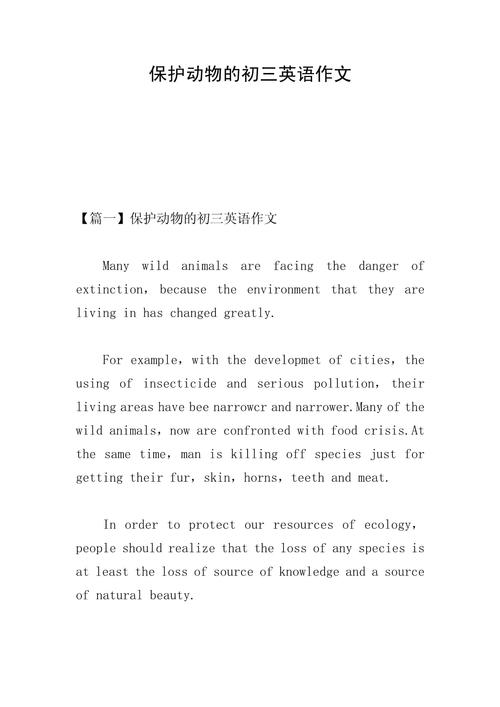
This is very sad. If animals disappear, our world will become a sad place. We need to protect them. What can we do? We can stop buying things made from animals. We can also plant more trees and make our environment clean.
Protecting animals is protecting ourselves. Let's work together to save our animal friends.
标准版 (适合高中生或中级英语学习者)
The Urgent Need to Protect Animals**
In the symphony of life on Earth, animals play an indispensable role. They are not merely creatures that share our planet; they are vital threads in the intricate web of biodiversity. However, this delicate balance is under unprecedented threat, pushing numerous species to the brink of extinction. The primary culprits are human activities: rampant deforestation, rampant pollution, illegal poaching, and the climate crisis.
The consequences of this loss are far-reaching. The disappearance of a single species can trigger a domino effect, destabilizing entire ecosystems. For instance, the decline of pollinators like bees jeopardizes global food security. Furthermore, many animals hold immense potential for medical science, and their loss could mean cures for diseases remain undiscovered.
Therefore, protecting animals is not just an act of kindness; it is a critical necessity for our own survival. We must take immediate and concerted action. Governments should enact and enforce stricter laws against poaching and habitat destruction. As individuals, we can make a difference by reducing our carbon footprint, supporting conservation organizations, and raising awareness about the plight of endangered species. The time to act is now. Let us be the generation that ensures a future where all animals can thrive in harmony with humanity.
高级版 (适合大学生或英语水平较高者)
Beyond Sentiment: The Imperative of Animal Conservation in the Anthropocene**
The concept of animal protection has evolved from a sentimental concern for charismatic megafauna to a critical scientific and ethical imperative in the Anthropocene—the current geological epoch defined by human impact. The accelerating rate of species extinction, estimated to be hundreds of times higher than the natural background rate, constitutes a sixth mass extinction event, the driver of which is unequivocally anthropogenic. This crisis stems from a complex interplay of habitat loss, climate change, overexploitation, pollution, and invasive species.
The rationale for conservation extends far beyond ethical considerations. From an ecological perspective, each species, regardless of its perceived "usefulness," contributes to the resilience and stability of ecosystems. The loss of a keystone species, such as the wolf in Yellowstone, can fundamentally alter an ecosystem's structure and function. Economically, intact ecosystems provide invaluable services, including pollination of crops, purification of water, and regulation of climate. Biomedicine also relies on biodiversity; a vast number of modern pharmaceuticals are derived from natural compounds found in animals and plants.
Consequently, a paradigm shift is required. Conservation must move from reactive protection to proactive restoration and sustainable coexistence. This necessitates a multi-pronged approach: strengthening international treaties like CITES (the Convention on International Trade in Endangered Species), promoting habitat corridors to connect fragmented landscapes, investing in renewable energy to mitigate climate change, and fostering a global culture of stewardship. Education is paramount in dispelling anthropocentric views and cultivating a profound respect for intrinsic value of all life. Ultimately, our commitment to animal conservation is a litmus test for our own humanity and our ability to secure a viable future for all life on Earth.
核心词汇与短语
Nouns (名词):
- Conservation: 保护 (比 protection 更正式,强调“合理利用与保存”)
- Biodiversity: 生物多样性
- Ecosystem: 生态系统
- Endangered species: 濒危物种
- Habitat: 栖息地
- Extinction: 灭绝
- Poaching / Illegal hunting: 偷猎
- Deforestation: 森林砍伐
- Pollution: 污染
- Climate change: 气候变化
- Wildlife: 野生动物
- Intrinsic value: 内在价值
- Stewardship: 管理职责,守护
Verbs (动词):
- To protect / To conserve: 保护
- To preserve: 保存,维护
- To endanger: 使...处于危险中
- To threaten: 威胁
- To destroy: 破坏
- To advocate for: 倡导,主张
- To raise awareness: 提高意识
- To mitigate / To alleviate: 减轻,缓解
- To coexist with: 与...共存
Adjectives (形容词):
- Endangered: 濒危的
- Threatened: 受到威胁的
- Vital / Essential / Crucial / Indispensable: 至关重要的
- Sustainable: 可持续的
- Illegal: 非法的
- Charismatic: (动物)有魅力的,吸引人的 (常指大熊猫、老虎等)
- Fragmented: (栖息地)零碎的,片断化的
Useful Phrases & Sentence Starters (实用短语和句型):
- 引出话题:
- Animals play a vital/crucial role in our ecosystem.
- The issue of animal protection has become increasingly prominent.
- In the symphony of life, animals are indispensable notes.
- 阐述原因:
- The primary causes for this situation are... / The main reasons are...
- This crisis is driven by a combination of factors, such as...
- Human activities, particularly... pose a severe threat to...
- 阐述影响/后果:
- The consequences of this loss are far-reaching.
- The disappearance of a species can trigger a domino effect.
- This not only affects animals but also jeopardizes our own future.
- 提出解决方案:
- Therefore, it is imperative that we take immediate action.
- To address this issue, a multi-pronged approach is required.
- We can make a difference by... / As individuals, we can...
- 总结观点:
- In conclusion, protecting animals is not just an option, but a necessity.
- Ultimately, our commitment to animal conservation reflects our values as a society.
- Let us work together to ensure a future where all life can thrive.
希望这些版本和资料能对您有所帮助!您可以根据自己的需求选择合适的版本进行修改和使用。