英语作文关于端午节
作文示例 2026年1月5日 04:07:31 99ANYc3cd6
初级水平
这个版本使用简单的词汇和句型,适合英语初学者。 Dragon Boat Festival**
The Dragon Boat Festival is a very important festival in China. We celebrate it on the fifth day of the fifth month of the lunar calendar.
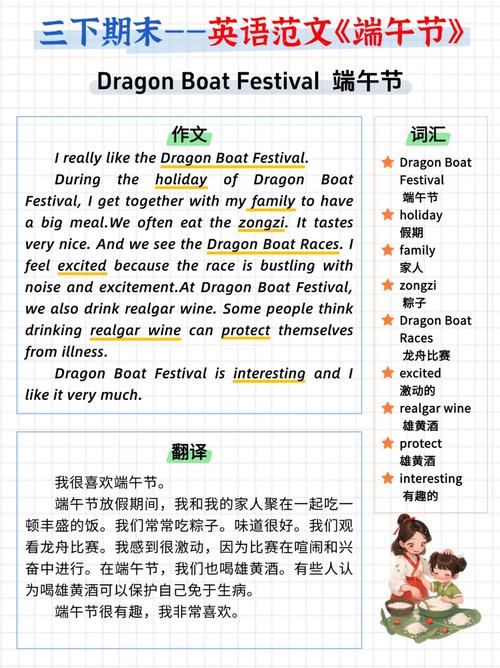
On this day, people often eat zongzi. Zongzi is made of glutinous rice with different fillings inside. It is very delicious. We also have dragon boat races. Many people sit in a long, colorful boat and row very fast on the river. It is exciting!
The Dragon Boat Festival has a story behind it. It is about a poet named Qu Yuan. People loved him and wanted to save him. They threw zongzi into the river so the fish would not eat his body. That is why we eat zongzi and have dragon boat races today.
I love the Dragon Boat Festival because it is fun and I can eat tasty zongzi with my family.
中级水平
这个版本使用更丰富的词汇和多样的句型,适合有一定英语基础的学习者。 The Dragon Boat Festival: A Celebration of Tradition and Courage**

The Dragon Boat Festival, also known as Duanwu Festival, is a vibrant and culturally significant holiday celebrated in China and other parts of Asia. It falls on the fifth day of the fifth month of the lunar calendar. This ancient festival is a rich tapestry of delicious food, thrilling sports, and a poignant historical legend.
The most iconic customs of the festival are eating zongzi and watching dragon boat races. Zongzi, sticky rice dumplings wrapped in bamboo or reed leaves, come in various sweet and savory flavors. They are not only a culinary delight but also a symbol of tradition. The dragon boat races are equally spectacular. Teams of padders energetically row long, ornate boats shaped like dragons, accompanied by the beating of drums. This exciting sport creates a lively and competitive atmosphere.
These customs are deeply rooted in a touching story from ancient China. The festival commemorates the patriotic poet Qu Yuan. When his kingdom was defeated, Qu Yuan tragically drowned himself in a river. Grieving locals raced out in their boats to try and save him and desperately threw zongzi into the water to feed the fish, hoping to prevent them from eating his body.
In conclusion, the Dragon Boat Festival is more than just a holiday. It is a time for families to come together, honor a historical hero, and enjoy the spirit of community. It beautifully combines remembrance with celebration, making it a unique and cherished part of Chinese culture.

高级水平
这个版本使用更复杂的句式、学术性的词汇和更深入的文化分析,适合英语水平较高的学习者。 The Dragon Boat Festival: An Introspection into China's Cultural Fabric**
The Dragon Boat Festival, or Duanwu Jie, stands as one of the most profound and dynamic festivals in the Chinese cultural calendar. Observed on the fifth day of the fifth lunar month, it is a multifaceted celebration that weaves together a rich tapestry of mythology, gastronomy, athleticism, and ancestral veneration. Far more than a mere public holiday, it serves as a living testament to China's enduring historical legacy and communal spirit.
At the heart of the festival are two quintessential customs: the consumption of zongzi and the exhilarating spectacle of dragon boat racing. Zongzi, glutinous rice parcels meticulously enveloped in bamboo or reed leaves, are a culinary artifact with deep symbolic resonance. Their diverse fillings, ranging from savory meat to sweet red bean paste, cater to a wide palate, but their primary role is to connect the present generation to the past. Concurrently, the dragon boat races are a breathtaking display of synchronized strength and teamwork. The thunderous roar of drums and the rhythmic chanting of paddlers transform the riverbanks into a fervent arena, symbolizing the collective effort of a community.
These traditions are inextricably linked to the poignant legend of Qu Yuan, a revered minister and poet of the Warring States period. Following the tragic downfall of his state, Qu Yuan, filled with despair and loyalty, chose to end his life by drowning himself in the Miluo River. In a poignant act of remembrance, local fishermen raced their boats to search for his body and threw rice balls into the river to satiate the fish, thereby preserving his body from desecration. This act of communal reverence is the genesis of the festival's most cherished practices.
In essence, the Dragon Boat Festival is a profound cultural phenomenon. It is a confluence of solemn commemoration and exuberant festivity, a day when the past is honored through the very act of celebration. It encapsulates core Chinese values such as filial piety, patriotism, and the importance of community, ensuring that the stories and spirits of ancestors continue to resonate in the modern era.
核心词汇和短语
| 词汇/短语 | 中文释义 |
|---|---|
| Dragon Boat Festival | 端午节 |
| Lunar calendar | 农历 |
| Zongzi / Zongzi | 粽子 |
| Glutinous rice | 糯米 |
| Fillings | 馅料 |
| Dragon boat race | 赛龙舟 |
| Paddler | 划桨手 |
| Drum | 鼓 |
| Legend / Myth | 传说,神话 |
| Commemorate | 纪念 |
| Patriotic poet | 爱国诗人 |
| Qu Yuan | 屈原 |
| Drowned himself | 投水自尽 |
| Dumpling | 饺子,团子 |
| Symbolism | 象征意义 |
| Cultural significance | 文化意义 |
| Ancestral veneration | 祭祖,祖先崇拜 |
| Inextricably linked | 密不可分地联系 |
| Poignant legend | 令人心酸的传说 |
| Community / Communal spirit | 社区精神,集体精神 |
| Vibrant / Profound | 充满活力的,深刻的 |
| Iconic custom | 具有代表性的习俗 |
希望这些材料对你有帮助!你可以根据自己的需求选择合适的版本进行学习和模仿。