低头族英语作文,如何拒绝低头,拥抱真实?
作文示例 2025年12月21日 17:15:20 99ANYc3cd6
Version 1: General Version (通用版)
Raise Your Head, Reconnect with the World**
In the modern era, smartphones have become an indispensable part of our lives. They connect us with information and loved ones, making the world smaller and more accessible. However, this constant connection has given rise to a new phenomenon: "Phubbing," or the act of snubbing others to focus on one's phone. The "head-down tribe," as they are known, is everywhere, and this habit is silently eroding the quality of our real-world interactions and personal well-being.
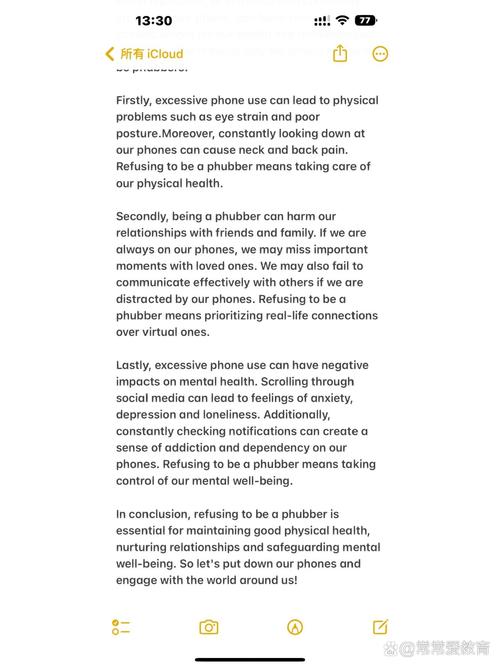
The most obvious consequence of being a "phubber" is the damage to our relationships. Imagine having dinner with friends or family, only to see everyone engrossed in their own phones, scrolling through social media or responding to messages. This lack of presence sends a clear message: "The screen in front of me is more important than you." It creates a barrier between people, replacing meaningful conversation with shallow digital exchanges. Over time, this can lead to feelings of loneliness and isolation, even when we are surrounded by others.
Furthermore, being glued to our phones poses significant physical dangers. We have all heard the stories of people walking into poles, tripping on the street, or, even worse, getting into accidents while driving. These are not just isolated incidents but a direct result of divided attention. By focusing on a small screen, we become oblivious to the world around us, putting our own safety and that of others at risk.
Finally, overusing our smartphones can negatively impact our mental health. The endless stream of curated, perfect lives on social media can lead to feelings of inadequacy and anxiety. We compare our own realities to the highlight reels of others, often feeling that we are falling short. This constant digital stimulation also prevents our minds from ever truly resting, leading to stress and sleep deprivation.
In conclusion, while technology offers incredible benefits, we must not let it control our lives. It is time to reclaim our attention and our connections. Let's make a conscious effort to "raise our heads." Let's put our phones away during meals, engage in genuine conversations with people, and appreciate the beauty of the physical world around us. By doing so, we can break free from the "head-down tribe" and build stronger, healthier relationships with ourselves and others.

Version 2: Advanced Version (进阶版)
The Digital Cage: Escaping the Tyranny of the "Head-Down Tribe"**
We live in an age of unprecedented digital connectivity. Smartphones, the portals to this vast digital universe, have promised to enrich our lives, yet they have inadvertently forged a new societal subculture: the "head-down tribe." This collective, characterized by its bowed posture and illuminated faces, represents a profound paradox. While more connected than ever, its members are often profoundly disconnected from the immediate, tangible reality, surrendering their agency to the seductive glow of a screen.
The social ramifications of this phenomenon are deeply troubling. The act of "phubbing"—a portmanteau of "phone" and "snubbing"—has become a corrosive element in interpersonal dynamics. In communal spaces, from family dinners to board meetings, the physical presence of individuals is no longer synonymous with their cognitive or emotional availability. This digital absentia breeds a culture of superficial engagement, where authentic dialogue is supplanted by fragmented, asynchronous communication. The result is a gradual erosion of empathy and a fraying of the social fabric, as genuine human connection is sacrificed for the fleeting validation of a "like" or a notification.
Beyond the social sphere, the physical and psychological toll is equally alarming. The ubiquity of "smartphone zombies" navigating public spaces has turned sidewalks and streets into veritable obstacle courses, creating a tangible public safety hazard. More insidiously, the pervasive influence of social media fosters a culture of comparison and curated perfection. The constant exposure to idealized versions of others' lives can trigger a detrimental cycle of envy, anxiety, and diminished self-worth. Our brains, bombarded by a relentless stream of information, are denied the essential respite required for deep thought, creativity, and genuine mental recovery.
Therefore, the imperative to reject the "head-down" lifestyle is not a Luddite rejection of technology, but a call for mindful integration. It is a plea for digital mindfulness and a reassertion of our humanity. We must consciously delineate boundaries between the digital and the physical world. This means designating "phone-free" zones and times, prioritizing face-to-face interactions, and cultivating the art of being present. By choosing to look up from our screens, we do not merely avoid accidents or social faux pas; we reclaim our capacity for wonder, foster deeper relationships, and rediscover the profound beauty of the world that exists beyond the glass and metal in our hands. It is time to break free from the digital cage and embrace the richness of life, one lifted head at a time.
Version 3: Short Version (简短版)
Let's Look Up and Live**
Our smartphones are wonderful tools, but they are turning too many of us into a "head-down tribe," always looking down at a screen. This habit is hurting us in three main ways.
First, it ruins our relationships. When we are always on our phones, we ignore the people right in front of us. This makes our friends and family feel unimportant, and we miss out on real conversations.
Second, it's dangerous. Walking or driving while looking at a phone can lead to serious accidents. We are not paying attention to the world, putting ourselves and others at risk.
Finally, it's bad for our mental health. Seeing everyone else's "perfect" life online can make us feel anxious and unhappy. We compare ourselves to these fake images and feel like we are not good enough.
It's time for a change. Let's put our phones down during meals and time with loved ones. Let's look up, notice the world around us, and talk to each other for real. By doing this, we can have better, safer, and happier lives. Let's all agree to look up and start living again.