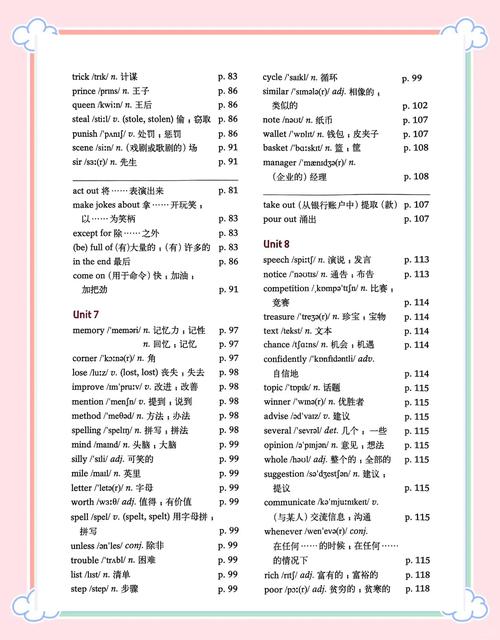
这个单词表按照 Module(模块) 和 Unit(单元) 进行了划分,方便您对照课本进行学习和复习,每个单词都包含了 音标、词性 和 核心中文释义,并附有 例句 来帮助理解其在语境中的用法。
Module 1 Getting along with others
Unit 1 Friends
| 单词 |
音标 |
词性 |
中文释义 |
例句 |
| generous |
/ˈdʒenərəs/ |
adj. |
慷慨的;大方的 |
He is very generous and always shares his toys. (他非常慷慨,总是分享他的玩具。) |
| hard-working |
/ˌhɑːd ˈwɜːkɪŋ/ |
adj. |
勤奋的;努力工作的 |
She is a hard-working student and gets good grades. (她是个勤奋的学生,成绩很好。) |
| practical |
/ˈpræktɪkl/ |
adj. |
实际的;务实的 |
He gave me some practical advice. (他给了我一些实用的建议。) |
| organize |
/ˈɔːɡənaɪz/ |
v. |
组织;安排 |
Can you organize a birthday party for me? (你能为我组织一个生日派对吗?) |
| similar |
/ˈsɪmələ(r)/ |
adj. |
相似的;类似的 |
My new bag is similar to yours. (我的新包和你的很像。) |
| truly |
/ˈtruːli/ |
adv. |
真正地;真实地 |
I truly appreciate your help. (我真心感谢你的帮助。) |
| care for |
/keə fɔː(r)/ |
phr. |
照顾;喜欢 |
Who will care for the children while we are away? (我们不在的时候谁来照顾孩子们?) |
| be similar to |
/biː ˈsɪmələ tuː/ |
phr. |
与...相似 |
Her dress is similar to mine. (她的裙子和我的一样。) |
| slim |
/slɪm/ |
adj. |
苗条的;纤细的 |
She does exercise to keep slim. (她为了保持苗条而锻炼。) |
| curly |
/ˈkɜːli/ |
adj. |
卷曲的 |
She has long curly hair. (她有一头长长的卷发。) |
| straight |
/streɪt/ |
adj. |
直的 |
He has straight black hair. (他有黑色的直发。) |
| glasses |
/ˈɡlɑːsɪz/ |
n. |
眼镜 |
The old man wears glasses to read. (那位老人戴眼镜看书。) |
| sense of humour |
/sens əv ˈhjuːmə(r)/ |
n. |
幽默感 |
A good sense of humour is very important. (良好的幽默感非常重要。) |
Unit 2 Best friends
| 单词 |
音标 |
词性 |
中文释义 |
例句 |
| joke |
/dʒəʊk/ |
n. |
笑话;玩笑 |
He told a funny joke and everyone laughed. (他讲了个有趣的笑话,大家都笑了。) |
| laugh |
/lɑːf/ |
v. & n. |
笑;大笑 |
Don't laugh at him. It's not funny. (别嘲笑他,这不好笑。) |
| lie |
/laɪ/ |
v. & n. |
说谎;谎言 |
He lied to his parents. (他对父母撒了谎。) |
| honest |
/ˈɒnɪst/ |
adj. |
诚实的;正直的 |
An honest person always tells the truth. (一个诚实的人总是说实话。) |
| get on with |
/ɡet ɒn wɪð/ |
phr. |
与...和睦相处 |
I get on well with my classmates. (我和我的同学相处得很好。) |
| support |
/səˈpɔːt/ |
v. & n. |
支持;支撑 |
My family always supports me. (我的家人总是支持我。) |
| jealous |
/ˈdʒeləs/ |
adj. |
嫉妒的;羡慕的 |
She felt jealous when she saw my new phone. (她看到我的新手机时感到很嫉妒。) |
| neither...nor... |
/ˈnaɪðə(r)... nɔː(r).../ |
conj. |
既不...也不... |
He is neither a teacher nor a doctor. (他既不是老师也不是医生。) |
| neat |
/niːt/ |
adj. |
整洁的;干净的 |
Her room is always neat and tidy. (她的房间总是干净整洁。) |
| tidy |
/ˈtaɪdi/ |
adj. |
整洁的 |
Please keep your desk tidy. (请保持你的书桌整洁。) |
| rubbish |
/ˈrʌbɪʃ/ |
n. |
垃圾;废物 |
Please put the rubbish in the bin. (请把垃圾放进垃圾桶里。) |
Module 2 Our daily life
Unit 3 Daily life
| 单词 |
音标 |
词性 |
中文释义 |
例句 |
| daily |
/ˈdeɪli/ |
adj. & adv. |
每日的(地) |
What's your daily routine? (你的日常作息是怎样的?) |
| routine |
/ruːˈtiːn/ |
n. |
常规;例行公事 |
I follow my morning routine every day. (我每天都遵循我的晨间常规。) |
| wake up |
/weɪk ʌp/ |
phr. |
醒来 |
I wake up at 6:30 every morning. (我每天早上6:30起床。) |
| brush |
/brʌʃ/ |
v. & n. |
刷;刷子 |
I brush my teeth twice a day. (我一天刷两次牙。) |
| shower |
/ˈʃaʊə(r)/ |
n. & v. |
淋浴;淋浴 |
I take a shower before breakfast. (我在早餐前洗个淋浴。) |
| start |
/stɑːt/ |
v. |
开始 |
Classes start at 8:00 a.m. (早上8点开始上课。) |
| finish |
/ˈfɪnɪʃ/ |
v. |
结束 |
When do you finish your homework? (你什么时候完成作业?) |
| have lessons |
/hæv ˈlesnz/ |
phr. |
上课 |
We have lessons from Monday to Friday. (我们从周一到周五上课。) |
| do one's homework |
/duː wʌnz ˈhəʊmwɜːk/ |
phr. |
做作业 |
I must do my homework now. (我现在必须做作业了。) |
| chat |
/tʃæt/ |
v. & n. |
聊天 |
I like to chat with my friends online. (我喜欢和朋友们在网上聊天。) |
| relax |
/rɪˈlæks/ |
v. |
放松;休息 |
You should relax for a while. (你应该放松一下。) |
| hardly |
/ˈhɑːdli/ |
adv. |
几乎不 |
I hardly ever go to the cinema. (我几乎不去电影院。) |
| once |
/wʌns/ |
adv. |
一次;曾经 |
I go to the gym once a week. (我一周去一次健身房。) |
| twice |
/twaɪs/ |
adv. |
两次 |
I eat twice a day. (我一天吃两顿饭。) |
| exercise |
/ˈeksəsaɪz/ |
n. & v. |
锻炼;练习 |
You should do more exercise. (你应该多做锻炼。) |
Unit 4 How do you get to school?
| 单词 |
音标 |
词性 |
中文释义 |
例句 |
| transport |
/trænˈspɔːt/ |
n. |
交通;运输 |
What's your favourite transport? (你最喜欢的交通方式是什么?) |
| by bus |
/baɪ bʌs/ |
phr. |
乘公交车 |
I go to school by bus. (我乘公交车去上学。) |
| by underground |
/baɪ ˌʌndəˈɡraʊnd/ |
phr. |
乘地铁 |
It's faster to go there by underground. (乘地铁去那里更快。) |
| on foot |
/ɒn fʊt/ |
phr. |
步行 |
My home is not far, so I go to school on foot. (我家不远,所以我步行去上学。) |
| take the subway |
/teɪk ðə ˈsʌbweɪ/ |
phr. |
乘地铁 |
He takes the subway to work every day. (他每天乘地铁去上班。) |
| walk |
/wɔːk/ |
v. & n. |
走;步行 |
Let's walk to the park. (我们步行去公园吧。) |
| kilometre |
/kɪˈlɒmɪtə(r)/ |
n. |
千米;公里 |
My school is about two kilometres away. (我的学校大约有两公里远。) |
| far |
/fɑː(r)/ |
adj. & adv. |
远的(地) |
The station is not far from here. (车站离这里不远。) |
| near |
/nɪə(r)/ |
adj. & prep. |
近的;在...附近 |
The supermarket is very near our school. (超市离我们学校很近。) |
| north |
/nɔːθ/ |
n. & adj. |
北;北方的 |
Beijing is in the north of China. (北京在中国的北部。) |
| south |
/saʊθ/ |
n. & adj. |
南;南方的 |
Sydney is a city in the south of Australia. (悉尼是澳大利亚南部的一座城市。) |
| east |
/iːst/ |
n. & adj. |
东;东方的 |
The sun rises in the east. (太阳从东方升起。) |
| west |
/west/ |
n. & adj. |
西;西方的 |
Go west for two blocks. (向西走两个街区。) |
| direction |
/dəˈrekʃn/ |
n. |
方向 |
Can you tell me the direction to the library? (你能告诉我去图书馆的方向吗?) |
Module 3 Animals
Unit 5 Wild animals
| 单词 |
音标 |
词性 |
中文释义 |
例句 |
| wild |
/waɪld/ |
adj. |
野生的;野的 |
Wild animals should live in nature. (野生动物应该生活在自然环境中。) |
| panda |
/ˈpændə/ |
n. |
熊猫 |
Pandas are cute and lovely. (熊猫又可爱又讨人喜欢。) |
| zebra |
/ˈziːbrə/ |
n. |
斑马 |
Zebras have black and white stripes. (斑马有黑白相间的条纹。) |
| giraffe |
/dʒəˈrɑːf/ |
n. |
长颈鹿 |
The giraffe has a very long neck. (长颈鹿有很长的脖子。) |
| elephant |
/ˈelɪfənt/ |
n. |
大象 |
An elephant has a long trunk. (大象有长鼻子。) |
| lion |
/ˈlaɪən/ |
n. |
狮子 |
The lion is the king of the animals. (狮子是百兽之王。) |
| dolphin |
/ˈdɒlfɪn/ |
n. |
海豚 |
Dolphins are very smart. (海豚非常聪明。) |
| danger |
/ˈdeɪndʒə(r)/ |
n. |
危险 |
There is a danger of falling rocks. (有落石的危险。) |
| endangered |
/ɪnˈdeɪndʒəd/ |
adj. |
濒临灭绝的 |
Many animals are endangered. (许多动物都濒临灭绝。) |
| protect |
/prəˈtekt/ |
v. |
保护 |
We must protect the environment. (我们必须保护环境。) |
| save |
/seɪv/ |
v. |
拯救;节省 |
We should try to save endangered animals. (我们应该努力拯救濒危动物。) |
| in danger |
/ɪn ˈdeɪndʒə(r)/ |
phr. |
处于危险中 |
This species is in danger. (这个物种正处于危险中。) |
| cut down |
/kʌt daʊn/ |
phr. |
砍倒 |
We shouldn't cut down too many trees. (我们不应该砍伐太多的树。) |
Unit 6 Animals in danger
| 单词 |
音标 |
词性 |
中文释义 |
例句 |
| fur |
/fɜː(r)/ |
n. |
毛皮;毛 |
The fox has a beautiful coat of fur. (狐狸有一身美丽的毛皮。) |
| pollution |
/pəˈluːʃn/ |
n. |
污染 |
Pollution is a serious problem. (污染是一个严重的问题。) |
| loss |
/lɒs/ |
n. |
丧失;损失 |
The loss of forests is a big problem. (森林的丧失是个大问题。) |
| habitat |
/ˈhæbɪtæt/ |
n. |
栖息地 |
We must protect the animals' habitats. (我们必须保护动物的栖息地。) |
| huge |
/hjuːdʒ/ |
adj. |
巨大的 |
The whale is a huge animal. (鲸是一种巨大的动物。) |
| as a result |
|
phr. |
结果 |
He was late as a result of the heavy traffic. (由于交通拥堵,他迟到了。) |
| famous |
/ˈfeɪməs/ |
adj. |
著名的 |
He is a famous singer. (他是一位著名的歌手。) |
| for example |
|
phr. |
例如 |
Many animals, for example, pandas and tigers, are in danger. (许多动物,例如熊猫和老虎,都处于危险中。) |
| die out |
|
phr. |
灭绝;逐渐消失 |
Some animals are in danger of dying out. (一些动物有灭绝的危险。) |
| law |
/lɔː/ |
n. |
法律 |
We should obey the law. (我们应该遵守法律。) |
| punish |
/ˈpʌnɪʃ/ |
v. |
惩罚 |
The police will punish the driver. (警察会惩罚那个司机。) |
| catch |
/kætʃ/ |
v. |
抓住;捕获 |
The cat tried to catch the mouse. (那只猫试图抓住老鼠。) |
Module 4 Numbers and life
Unit 7 Numbers
| 单词 |
音标 |
词性 |
中文释义 |
例句 |
| population |
/ˌpɒpjuˈleɪʃn/ |
n. |
人口 |
The population of China is over 1.4 billion. (中国的人口超过14亿。) |
| increase |
/ɪnˈkriːs/ |
v. & n. |
增加;增长 |
Our profits increased by 20%. (我们的利润增长了20%。) |
| billion |
/ˈbɪljən/ |
num. |
十亿 |
The country has a billion people. (这个国家有十亿人口。) |
| percent |
/pəˈsent/ |
n. |
百分之... |
About 50 percent of the students are girls. (大约50%的学生是女孩。) |
| double |
/ˈdʌbl/ |
adj. & v. |
两倍的;使加倍 |
The price doubled in one year. (价格在一年内翻了一番。) |
| produce |
/prəˈdjuːs/ |
v. |
生产;制造 |
This factory produces cars. (这家工厂生产汽车。) |
| wealth |
/welθ/ |
n. |
财富;财产 |
He gained great wealth from his business. (他从生意中获得了巨大的财富。) |
| divide |
/dɪˈvaɪd/ |
v. |
分;划分 |
Please divide the cake into four. (请把蛋糕分成四份。) |
| by-product |
/ˈbaɪ prɒdʌkt/ |
n. |
副产品 |
Pollution is a by-product of industrial development. (污染是工业发展的副产品。) |
| figure |
/ˈfɪɡə(r)/ |
n. |
数字;人物 |
The figure on the screen is changing. (屏幕上的数字在变化。) |
| report |
/rɪˈpɔːt/ |
v. & n. |
报告;报道 |
He reported the accident to the police. (他向警方报告了这起事故。) |
| compare |
/kəmˈpeə(r)/ |
v. |
比较 |
It's interesting to compare the two cultures. (比较这两种文化很有趣。) |
| compared to |
|
phr. |
与...相比 |
Compared to last year, our sales are much better. (与去年相比,我们的销售好多了。) |
Unit 8 Time
| 单词 |
音标 |
词性 |
中文释义 |
例句 |
| ancient |
/ˈeɪnʃnt/ |
adj. |
古代的;古老的 |
Ancient Greece was a great civilization. (古希腊是一个伟大的文明。) |
| measure |
/ˈmeʒə(r)/ |
v. & n. |
测量;措施 |
We need to measure the room. (我们需要测量一下这个房间。) |
| sundial |
/ˈsʌndaiəl/ |
n. |
日晷 |
An sundial is an ancient clock. (日晷是一种古老的钟。) |
| candle |
/ˈkændl/ |
n. |
蜡烛 |
The room was lit by a candle. (房间被一支蜡烛照亮了。) |
| hourglass |
/ˈaʊəɡlɑːs/ |
n. |
沙漏 |
The hourglass ran out. (沙漏漏完了。) |
| invention |
/ɪnˈvenʃn/ |
n. |
发明;创造 |
The printing press was a great invention. (印刷机是一项伟大的发明。) |
| invent |
/ɪnˈvent/ |
v. |
发明;创造 |
Who invented the telephone? (谁发明了电话?) |
| pocket |
/ˈpɒkɪt/ |
n. |
口袋 |
Put your keys in your pocket. (把你的钥匙放在口袋里。) |
| accurate |
/ˈækjərət/ |
adj. |
精确的;准确的 |
This watch is very accurate. (这块表非常准。) |
| nowadays |
/ˈnaʊədeɪz/ |
adv. |
现在 |
Nowadays, people use smartphones a lot. (人们大量使用智能手机。) |
| meanwhile |
/ˈmiːnwaɪl/ |
adv. |
与此同时 |
I'll go to the supermarket. Meanwhile, you can clean the room. (我去超市,你可以打扫房间。) |
| second |
/ˈsekənd/ |
n. & v. |
秒;附议 |
There are 60 seconds in a minute. (一分钟有60秒。) |
| o'clock |
|
adv. ...点钟 |
It's five o'clock now. (现在是五点钟。) |
Module 5 Around the world
Unit 9 Computers
| 单词 |
音标 |
词性 |
中文释义 |
例句 |
| computer |
/kəmˈpjuːtə(r)/ |
n. |
电脑 |
I use my computer to do my homework. (我用我的电脑做作业。) |
| screen |
/skriːn/ |
n. |
屏幕 |
Don't sit too close to the screen. (不要坐得太靠近屏幕。) |
| keyboard |
/ˈkiːbɔːd/ |
n. |
键盘 |
You type on the keyboard. (你在键盘上打字。) |
| mouse |
/maʊs/ |
n. |
鼠标 |
My mouse is not working. (我的鼠标不灵了。) |
| click |
/klɪk/ |
v. & n. |
点击 |
Click the icon to open the file. (点击图标来打开文件。) |
| search |
/sɜːtʃ/ |
v. & n. |
搜索;搜寻 |
I need to search for some information online. (我需要在网上搜索一些信息。) |
| connect |
/kəˈnekt/ |
v. |
连接 |
Please connect the printer to the computer. (请把打印机连接到电脑上。) |
| online |
/ˌɒnˈlaɪn/ |
adj. & adv. |
在线的;在线地 |
I often shop online. (我经常网上购物。) |
| information |
/ˌɪnfəˈmeɪʃn/ |
n. |
信息 |
Can you give me some information about this city? (你能给我一些关于这个城市的信息吗?) |
| send |
/send/ |
v. |
发送;寄送 |
Please send me an email. (请给我发封电子邮件。) |
| receive |
/rɪˈsiːv/ |
v. |
收到;接收 |
I received a gift from my friend. (我收到了朋友送的一份礼物。) |
| download |
/ˌdaʊnˈləʊd/ |
v. |
下载 |
I want to download a new app. (我想下载一个新应用。) |
| upload |
/ˌʌpˈləʊd/ |
v. |
上传 |
Can you help me upload this photo? (你能帮我上传这张照片吗?) |
| password |
/ˈpɑːswɜːd/ |
n. |
密码 |
You need a password to log in. (你需要一个密码来登录。) |
Unit 10 The weather
| 单词 |
音标 |
词性 |
中文释义 |
例句 |
| weather |
/ˈweðə(r)/ |
n. |
天气 |
What's the weather like today? (今天天气怎么样?) |
| temperature |
/ˈtemprətʃə(r)/ |
n. |
温度 |
The temperature is 25 degrees. (温度是25度。) |
| sunny |
/ˈsʌni/ |
adj. |
晴朗的 |
It's a sunny day. (今天是个晴天。) |
| cloudy |
/ˈklaʊdi/ |
adj. |
多云的 |
It's cloudy today. (今天多云。) |
| windy |
/ˈwɪndi/ |
adj. |
有风的 |
It's very windy outside. (外面风很大。) |
| rainy |
/ˈreɪni/ |
adj. |
下雨的 |
It's a rainy day. (是个下雨天。) |
| snowy |
/ˈsnəʊi/ |
adj. |
下雪的 |
We had a snowy winter. (我们度过了一个多雪的冬天。) |
| forecast |
/ˈfɔːkɑːst/ |
n. & v. |
预报;预测 |
The weather forecast says it will rain tomorrow. (天气预报说明天会下雨。) |
| degree |
/dɪˈɡriː/ |
n. |
度 |
It's 30 degrees in summer. (夏天有30度。) |
| below |
/bɪˈləʊ/ |
prep. & adv. |
在...下面;低于 |
The temperature is below zero. (温度在零度以下。) |
| above |
/əˈbʌv/ |
prep. & adv. |
在...上面;高于 |
The plane flew above the clouds. (飞机在云层上方飞行。) |
| rise |
/raɪz/ |
v. |
上升;升起 |
The sun rises in the east. (太阳从东方升起。) |
| fall |
/fɔːl/ |
v. |
下降;落下 |
Leaves fall from trees in autumn. (秋天树叶从树上落下。) |
| umbrella |
/ʌmˈbrelə/ |
n. |
雨伞 |
Don't forget to take an umbrella. (别忘了带伞。) |
学习建议
- 分类记忆:可以将单词按主题(如外貌、交通、动物、天气)或词性(动词、名词、形容词)进行分类记忆。
- 语境记忆:不要孤立地背单词,一定要结合例句,理解单词在句子中的用法。
- 词根词缀:学习一些常见的词根词缀,可以帮助你猜测和记忆更多单词。
re- 表示“再,又”(receive, review),-less 表示“没有”(careless, useless)。
- 听说读写结合:
- 听:听课本录音,模仿发音。
- 说:尝试用新学的单词造句,与同学对话。
- 读:阅读包含这些单词的短文或故事。
- 写:用单词写日记、小作文或单词卡片。
- 定期复习:利用艾宾浩斯遗忘曲线,及时、定期地复习已学过的单词,可以大大提高记忆效率。
希望这份详细的单词表对您的英语学习有帮助!加油!