中考传统文化英语作文如何写?
作文示例 2025年12月19日 07:31:13 99ANYc3cd6
下面我将为你提供一个全面的备考指南,包括写作思路、高分词汇与句型、三篇不同角度的范文以及实用写作技巧,希望能帮助你取得好成绩。
Part 1: 写作思路与框架
中考作文通常要求120-150词,时间有限,因此一个清晰的结构至关重要,建议采用经典的“三段式”结构。

第一段:引言
- 开门见山:直接点明主题,介绍你所选择的传统文化元素(如:春节、书法、京剧等)。
- 概括重要性:简述它为何重要,是中华民族的瑰宝,体现了智慧和情感等。
- 引出下文:可以简要提及它的几个主要方面(如:历史、习俗、意义)。
第二段:主体
- 这是文章的核心,需要展开2-3个要点来详细描述。
- 历史与起源,它有多久的历史?它起源于什么故事或时期?
- 主要习俗/特点,人们是如何庆祝或实践的?(春节的贴春联、吃年夜饭;书法的运笔技巧;京剧的脸谱和唱腔)。
- 象征意义/文化价值,它代表了什么?(家庭团圆、和谐、吉祥、忠孝等)。
- 注意:不要堆砌信息,选择2-3个你最熟悉、最有话说的点来写。
第三段:结论
- 总结全文:重申该传统文化的重要性。
- 个人观点/展望:谈谈你对它的看法,或者作为青少年,我们应该如何传承和发扬它。
- 升华主题:可以将其与“文化自信”或“世界文化多样性”联系起来,提升文章立意。
Part 2: 高分词汇与句型储备
使用恰当的词汇和句型是获得高分的关键。

核心词汇
- 传统文化: Traditional Culture / Heritage
- 宝贵的: Precious / Valuable / Invaluable
- 瑰宝: Treasure / Gem
- 传承: Pass down / Inherit / Carry forward
- 象征: Symbolize / Represent
- 历史悠久: Have a long history / Date back to...
- 非物质文化遗产: Intangible Cultural Heritage
- 习俗: Custom / Tradition
- 起源: Origin / Root / Originate from
- 独特的: Unique / Distinctive
- 重要的组成部分: An important part of...
- 发扬光大: Develop and promote / Carry it forward
万能句型
- 引出主题:
- As a precious treasure of Chinese culture, ... is a significant part of our life.
- ... is one of the most traditional and important festivals/customs in China.
- 描述历史:
- With a history of over... years, ... dates back to the... Dynasty.
- The origin of... can be traced back to an ancient legend.
- 描述习俗/特点:
- During..., people usually... (e.g., get together, set off fireworks).
- It is characterized by... (e.g., its special costumes, beautiful melodies).
- What makes it special is...
- 表达意义:
- ... symbolizes... (e.g., happiness, reunion, good luck).
- It not only... but also... (e.g., entertains people, teaches us moral values).
- 总结与呼吁:
- In conclusion, ... plays an irreplaceable role in Chinese culture.
- As teenagers, it is our duty to learn about and pass down our traditional culture.
- Only by doing so can we keep our cultural roots alive and enhance our cultural confidence.
Part 3: 范文示例
这里提供三篇不同主题的范文,你可以根据自己的喜好和掌握程度进行学习和模仿。
春节
The Spring Festival: Our Most Cherished Tradition
The Spring Festival, also known as Chinese New Year, is the most important traditional festival in China. With a history of thousands of years, it is not just a holiday, but a deep-rooted cultural symbol that celebrates family reunion and new beginnings.
The celebration starts on New Year's Eve. Families travel from all over the country to gather for a big reunion dinner, where dishes like dumplings and fish are served for good luck. At midnight, people set off fireworks to scare away evil spirits and welcome the new year. During the festival, children are happy to receive "red envelopes" with lucky money from elders.
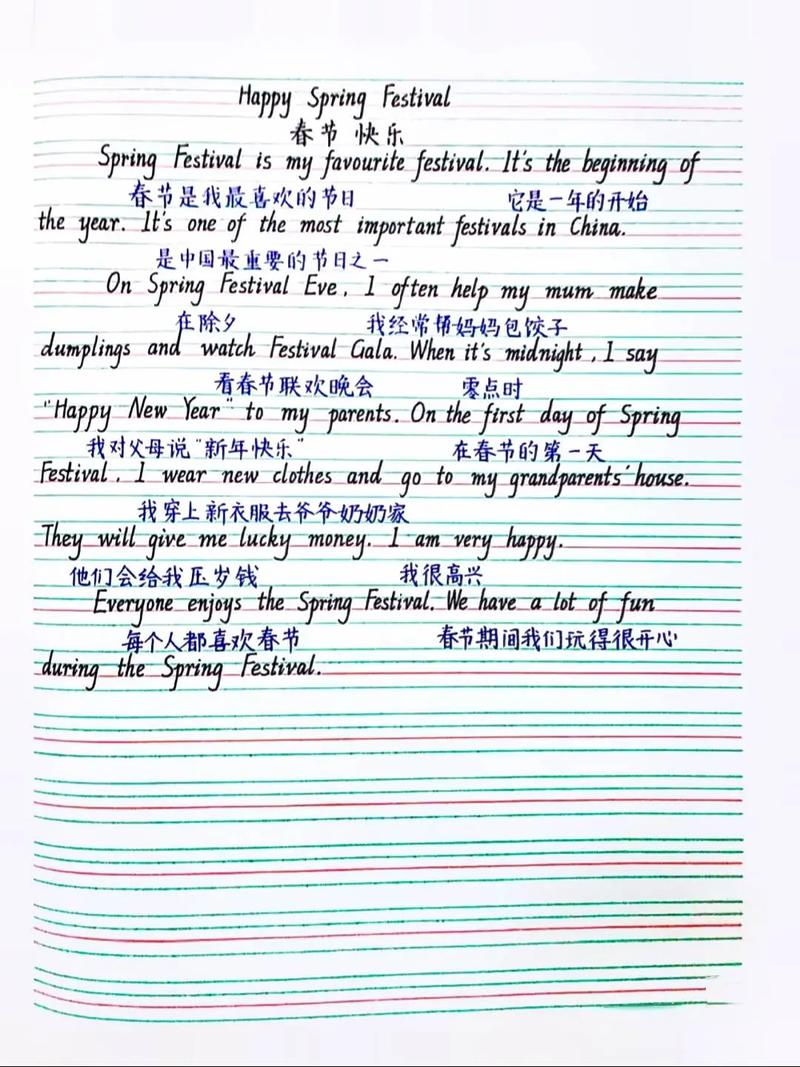
In my opinion, the Spring Festival is more than just a festival. It represents the core values of family love and hope for a better future. As young generations, we should carry forward this precious tradition and pass it on to the world.
(约120词)
中国书法
Chinese Calligraphy: An Art of Beauty
Among China's rich traditional arts, Chinese calligraphy stands out as a unique and elegant treasure. It is not just a way of writing, but a profound art form that combines skill, emotion, and philosophy.
With a history spanning over 3,000 years, calligraphy uses a brush and ink to create beautiful characters on paper. It requires great control and a calm mind. The beauty of calligraphy lies not only in its structure but also in the "spirit" or "rhythm" conveyed by the strokes. Different styles, like Regular Script and Running Script, show various artistic expressions.
For me, practicing calligraphy is a peaceful journey. It helps me appreciate the beauty of our language and cultivates my patience. It is our responsibility to learn and protect this invaluable art, ensuring its spirit continues to shine brightly in the modern world.
(约120词)
京剧
Peking Opera: A Colorful Window to Chinese Culture
Peking Opera, a national treasure of China, is a traditional performing art that combines music, vocal performance, mime, dance, and acrobatics. As a masterpiece of the Intangible Cultural Heritage, it offers a colorful window into Chinese history and values.
Originating in the late 18th century, Peking Opera is famous for its elaborate costumes, symbolic makeup, and unique melodies. Performers use different colors on their faces to represent different characters' personalities—red for loyalty, black for integrity, and white for treachery. The music, played with traditional instruments like the jinghu and drums, tells stories from ancient legends and historical events.
Though it might seem complex to some, Peking Opera is full of artistic charm. It tells us stories about heroes, villains, and the eternal struggle between good and evil. We young people should try to understand and love this art form, helping it find its place in the 21st century.
(约125词)
Part 4: 实用写作技巧
- 选择你最熟悉的主题:不要选择你一知半解的文化现象,写自己有把握的内容才能避免错误。
- 先列提纲,再动笔:花2分钟构思好每一段要写什么要点,可以防止写作时思路混乱或遗漏内容。
- 善用“连接词”:使用
Firstly,Secondly,Besides,Moreover,However,In conclusion等词,让文章逻辑更清晰,结构更严谨。 - 句式多变,避免重复:尝试使用简单句、并列句和复合句,把 "I like Spring Festival. It is fun." 合并成 "I like Spring Festival because it is fun and full of joy."
- 书写工整,卷面整洁:在中考中,清晰美观的书写能给阅卷老师留下良好的第一印象。
- 检查,检查,再检查:写完后,快速通读一遍,检查是否有拼写错误、语法错误或时态问题,这是提分的关键一步!
希望这份详细的指南能对你有所帮助,祝你中考顺利,取得理想的成绩!