人教版七年级英语语法核心难点有哪些?
校园之窗 2026年1月18日 22:43:54 99ANYc3cd6
人教版七年级英语核心语法总览
七年级的语法可以大致分为以下几个模块:
Be 动词 人称代词和物主代词 名词 冠词 There be 句型 介词 一般现在时 现在进行时 情态动词 can 祈使句 模块十一:名词所有格 模块十二:一般过去时 (七年级下册重点)
Be 动词
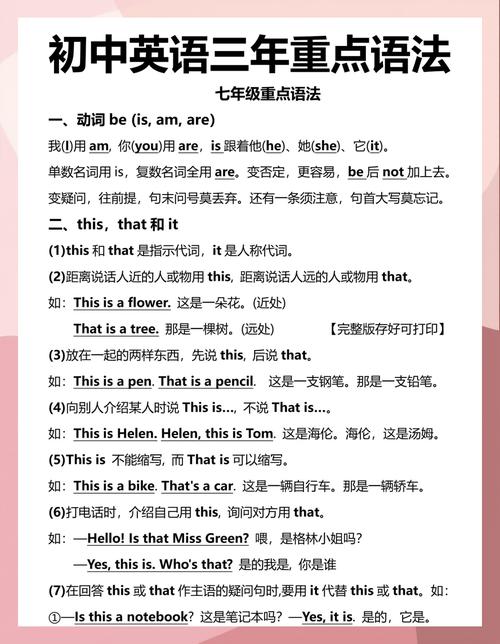
Be 动词是英语中最核心的动词,用来表示“是”、“在”、“有”等状态,七年级主要掌握 am, is, are 的用法。
用法口诀:
我用 am,你用 are,is 跟着他、她、它。 单数 is,复数 are,this that is 不用变。
具体用法:
- I + am -> I am a student. (我是学生。)
- You/We/They + are -> You are my friend. (你是我的朋友。) / They are teachers. (他们是老师。)
- He/She/It/单数名词 + is -> He is my brother. (他是我的哥哥。) / The book is on the desk. (书在桌子上。)
- This/That + is -> This is my pen. (这是我的钢笔。) / That is an apple. (那是一个苹果。)
句型转换:
- 肯定句: He is a doctor.
- 否定句: He is not / isn't a doctor. (在
is后面加not,可以缩写为isn't) - 一般疑问句: Is he a doctor? (把
is提到句首,大写)- 肯定回答: Yes, he is.
- 否定回答: No, he isn't.
人称代词和物主代词
这是学习英语的基础,用于代替人或物。
人称代词:代替人或事物作主语。
| 主格 | I (我) | you (你) | he (他) | she (她) | it (它) | we (我们) | they (他们/她们/它们) |
|---|---|---|---|---|---|---|---|
| 例句 | I like music. | You are right. | He is tall. | She is my sister. | It is a cat. | We are friends. | They are books. |
物主代词:表示“……的”,表明所属关系。
| 类型 | 中文含义 | my (我的) | your (你的) | his (他的) | her (她的) | its (它的) | our (我们的) | their (他们的/她们的/它们的) |
|---|---|---|---|---|---|---|---|---|
| 形容词性物主代词 | 后面必须跟名词 | my book | your school | his name | her bag | its tail | our class | their teacher |
| 名词性物主代词 | 本身=“形容词性物主代词+名词”,后面不跟名词 | mine | yours | his | hers | its | ours | theirs |
关键区别:
- 形容词性物主代词:后面必须有名词。
- This is my book. (这是我的书。)
- 名词性物主代词:后面没有名词,它本身就相当于一个名词。
- This book is mine. (这本书是我的。)
名词
表示人、事物、地点或概念的词。
可数名词与不可数名词:
-
可数名词:
- 特点: 可以用数字计算,有单复数形式。
- 规则复数: 在词尾加
-s(book -> books) 或-es(bus -> buses)。 - 不规则复数: 需要特殊记忆 (child -> children, man -> men, woman -> women, foot -> feet)。
- 用法: 前面可以加
a/an或具体的数字 (a book, two books)。
-
不可数名词:
- 特点: 无法用数字直接计算,通常只有单数形式。
- 常见类型: 液体 (water, milk)、气体 (air)、抽象概念 (love, time, information)、食物类 (bread, rice, chicken - 指肉时)。
- 用法: 不能直接加
s,前面不能加a/an,表示数量时,要借助a bottle of/much/a little/some等词。some water (一些水), a cup of tea (一杯茶), much money (很多钱), a little milk (一点牛奶)。
名词所有格:表示“……的”。
- 规则: 在名词后面加
's。- Tom's book (汤姆的书)
- my mother's car (我妈妈的车)
- 特殊情况:
- 以
s结尾的复数名词,只在 后加s。the teachers' office (老师们的办公室)
- 表示两个人共同拥有,只在最后一个名词后加
's。Lucy and Lily's room (露西和莉莉共有的房间)
- 表示两个人各自拥有,在每个名词后都加
's。Lucy's and Lily's rooms (露西的和莉莉各自的房间)
- 以
冠词
用在名词前,起限定作用,只有三个:a, an, the。
-
a / an (不定冠词): 表示泛指,指“一个”或“一类”中的任何一个。
- a: 用在以辅音音素开头的单词前。(不是辅音字母!)
a book (/bʊk/), a university (/ˌjuːnɪˈvɜːsəti/ - 以辅音 /j/ 开头)
- an: 用在以元音音素开头的单词前。(不是元音字母!)
an apple (/ˈæpl/), an hour (/ˈaʊə(r)/ - 以元音 /aʊ/ 开头)
- a: 用在以辅音音素开头的单词前。(不是辅音字母!)
-
the (定冠词): 表示特指,谈话双方都知道的人或物。
- The book on the desk is mine. (桌上的那本书是我的。——特指桌上的那本)
- I like the movie we saw yesterday. (我喜欢我们昨天看的那部电影。——特指昨天看的)
There be 句型
表示“在某地存在某物/某人”。
基本结构: There be + (名词) + (地点状语)
be 动词的确定:
- 就近原则:
be的形式由它后面最近的那个名词决定。- There is a book and two pens on the desk. (书是单数,所以用 is)
- There are two pens and a book on the desk. (钢笔是复数,所以用 are)
句型转换:
- 肯定句: There is a bird in the tree.
- 否定句: There isn't / aren't a bird in the tree. (根据 be 动词否定)
- 一般疑问句: Is/Are there a bird in the tree? (把 be 动词提前)
- 肯定回答: Yes, there is. / Yes, there are.
- 否定回答: No, there isn't. / No, there aren't.
介词
表示词与词之间关系的词,后面通常跟名词、代词或动名词。
七年级重点掌握:
- in (在...里面): in the box, in the classroom, in Beijing
- on (在...上面): on the desk, on the wall, on Monday
- at (在...点/小地点): at school, at home, at 8 o'clock
- under (在...下面): under the bed
- near (在...附近): near the park
- behind (在...后面): behind the tree
- next to (紧挨着): next to me
- for (为了...): Thank you for your help.
一般现在时
七年级上册最重要的时态。
用法:
- 表示经常性、习惯性的动作或状态。
- 表示客观事实或普遍真理。
- 在时间状语从句和条件状语从句中,表示将来的动作。
结构:
- 主语 + be 动词 + ... (见模块一)
- 主语 + 行为动词 + ...
行为动词的第三人称单数形式:
- 规则: 与名词复数规则类似。
- 一般加
-s(like -> likes) - 以 s, x, ch, sh, o 加
-es(go -> goes, watch -> watches) - 以“辅音字母+y”变 y 为 i 再加
-es(study -> studies)
- 一般加
- 口诀: 单三 he/she/it,动词后面加 s/es。
否定句和疑问句:
- 当句子有 be 动词时: 用
don't或doesn't。- 肯定句: He likes apples.
- 否定句: He doesn't like apples. (
doesn't后面的动词恢复原形) - 疑问句: Does he like apples? (
Does提前,动词恢复原形)- 肯定回答: Yes, he does.
- 否定回答: No, he doesn't.
现在进行时
七年级下册的重点时态。
用法:
- 表示说话时正在进行的动作。
- 表示当前一段时间内的活动或现阶段的状态。
结构: 主语 + am/is/are + 动词的-ing形式
动词-ing形式的构成:
- 一般直接加
-ing(go -> going) - 以不发音的
e去e加-ing(write -> writing) - 以“重读闭音节”即“辅音+元音+辅音”,双写末尾辅音再加
-ing(sit -> sitting, run -> running) - 以
ie变ie为y再加-ing(die -> dying, lie -> lying)
否定句和疑问句:
- 肯定句: I am reading a book.
- 否定句: I am not reading a book. (am not 缩写为
aren't,但I'm not更常用) - 疑问句: Are you reading a book?
- 肯定回答: Yes, I am.
- 否定回答: No, I am not / aren't.
情态动词 can
表示能力或许可。
用法:
- 表示“能,会”(能力)
- 表示“可以”(许可,请求)
结构: 主语 + can + 动词原形 + ...
否定句和疑问句:
- can not 缩写为 can't / cannot。
- 肯定句: I can swim.
- 否定句: I can't swim.
- 疑问句: Can you swim?
- 肯定回答: Yes, I can.
- 否定回答: No, I can't.
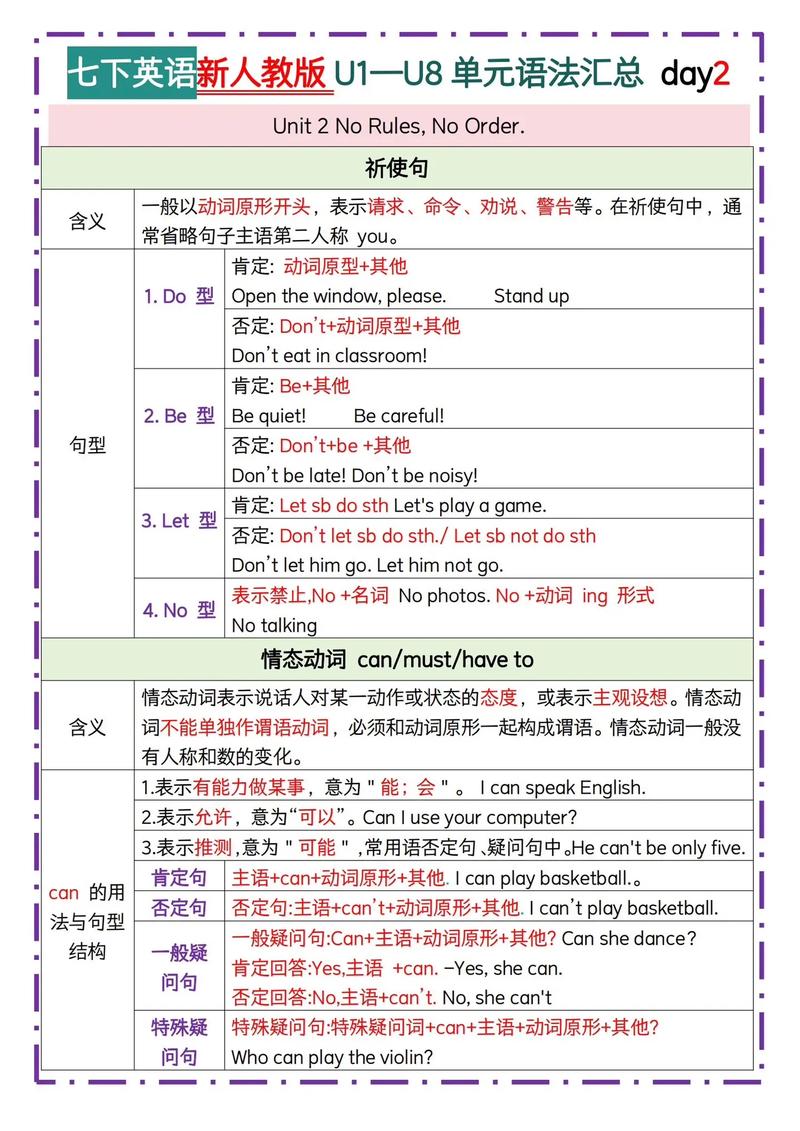
祈使句
用于表达命令、请求、建议、警告等。
肯定形式:
- 以动词原形开头。
- Open the door, please. (请开门。)
- Be quiet! (安静!)
- Let's go! (我们走吧!)
否定形式:
- 以 Don't + 动词原形开头。
- Don't be late. (不要迟到。)
- Don't open the window. (别打开窗户。)
模块十一:一般过去时 (七年级下册)
表示过去某个时间发生的动作或存在的状态。
结构: 主语 + was/were + ... (用于描述过去的状态) 主语 + 动词过去式 + ... (用于描述过去的动作)
be 动词的过去式:
- am/is -> was
- are -> were
- 口诀: 我用 was,你用 were,is 变 was,are 变 were。
动词过去式的构成:
- 规则动词:
- 一般直接加
-ed(look -> looked) - 以
e只加-d(live -> lived) - 以“辅音+y”变 y 为 i 再加
-ed(study -> studied) - 以“重读闭音节”双写末尾辅音再加
-ed(stop -> stopped)
- 一般直接加
- 不规则动词: 需要特殊记忆,如
go -> went,have -> had,do -> did,eat -> ate。
否定句和疑问句:
- 有 was/were 的句子:
- 肯定句: He was at home yesterday.
- 否定句: He wasn't at home yesterday.
- 疑问句: Was he at home yesterday?
- 有行为动词的句子:
- 肯定句: I played football last week.
- 否定句: I didn't play football last week. (
didn't后面的动词恢复原形) - 疑问句: Did you play football last week? (
Did提前,动词恢复原形)
学习建议
- 理解为主,死记为辅: 不要死记硬背规则,要理解每个语法的核心概念和用法,理解了“就近原则”,
There be句型就永远不会错。 - 在句子中学习: 不要孤立地背单词和规则,要把它们放到完整的句子里去理解和记忆。
- 多做练习,及时巩固: 语法知识通过练习才能真正掌握,多做课本配套的练习题和同步练习册。
- 建立错题本: 把自己做错的题目抄下来,写下正确答案和解析,定期复习,避免再犯同样的错误。
- 多听多说,培养语感: 听英文歌、看简单的英文动画、和同学用英语对话,这些都能帮助你潜移默化地掌握语法规则。
希望这份详细的梳理对你有帮助!祝你学习进步!