英语定语从句作文如何正确运用?
作文示例 2026年1月6日 08:05:29 99ANYc3cd6
下面我将从“为什么用”、“怎么用”、“高分范文”和“练习方法”四个方面,为你全面解析如何在英语作文中运用定语从句。
Part 1: 为什么在作文中使用定语从句?
定语从句就像一个“信息扩展器”,它能把简单的句子变得更具体、更有说服力。

对比一下:
-
简单句: The man is a teacher. He lives next door.
- 这个男人是老师,他住隔壁。
- (两个短句,信息独立,略显平淡)
-
使用定语从句: The man who lives next door is a teacher.
- 住隔壁的那个男人是老师。
- (一句话就把两个信息点完美地结合在一起,句子更紧凑,关系更明确)
使用定语从句的好处:
- 丰富句式: 避免通篇都是简单句,让文章结构有高有低,富有节奏感。
- 信息整合: 将多个相关信息点整合到一个句子中,逻辑更清晰。
- 表达精确: 可以对名词进行详细的描述和限定,让读者理解得更准确。
- 提升档次: 这是展示你语法功底和语言驾驭能力的标志,是获得高分作文的必备技能。
Part 2: 定语从句的核心用法
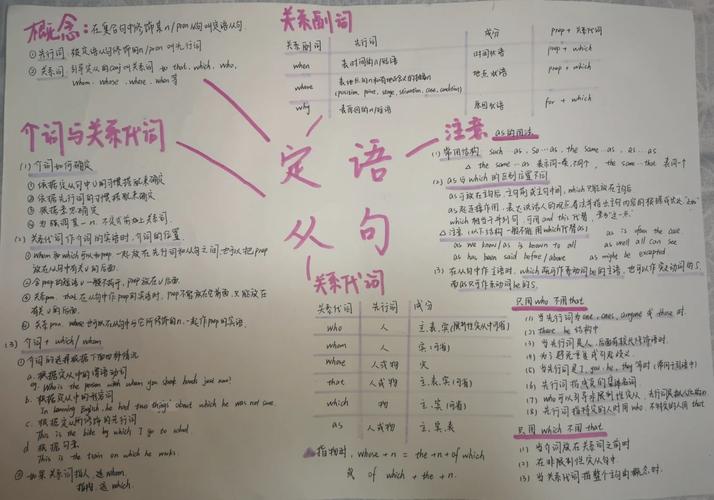
定语从句由“关系词 + 句子”构成,用来修饰前面的名词(先行词)。
A. 关系词的分类与选择
选择哪个关系词,取决于先行词在从句中充当的成分。
| 关系词 | 指代人 | 指代物 | 在从句中成分 | 举例 |
|---|---|---|---|---|
| that | ✓ | ✓ | 主语/宾语 | The book that I bought yesterday is interesting. (宾语) |
| which | ✓ | 主语/宾语 | The movie which was released last year was a hit. (主语) | |
| who | ✓ | 主语/宾语 | The student who won the prize is from my class. (主语) | |
| whom | ✓ | 宾语 | The professor whom we respect is very strict. (宾语,可省略) | |
| whose | ✓ | ✓ | 定语 (表...的) | This is the boy whose father is a doctor. |
| where | ✓ | 地点状语 | This is the town where I was born. | |
| when | ✓ | 时间状语 | I still remember the day when we first met. | |
| why | ✓ | 原因状语 | That is the reason why he was late. |
黄金法则:
- 缺主语/宾语 → 用
that,which,who,whom - 定语(...的) → 用
whose - 地点状语 → 用
where - 时间状语 → 用
when - 原因状语 → 用
why
B. 关系代词的省略
在限制性定语从句中,如果关系代词在从句中作宾语,可以省略。

- The book (that/which) I bought yesterday is interesting. (
I bought缺少宾语,that/which可省) - The person (who/whom/that) you should talk to is the manager. (
you should talk to缺少宾语,所以关系词可省)
C. 限制性 vs. 非限制性定语从句
这是非常重要的区别,尤其在写作中。
| 特征 | 限制性定语从句 | 非限制性定语从句 |
|---|---|---|
| 作用 | 修饰限定先行词,去掉后句意不完整。 | 补充说明先行词,去掉后句意仍然完整。 |
| 逗号 | 不加逗号 | 必须加逗号 |
| 关系词 | 可用 that |
不可用 that,只能用 which, who, whom |
| 翻译 | ...的 | ...,他/它... |
举例:
- 限制性: Students who cheat in exams will be punished.
作弊的学生将会受到惩罚。(强调是“作弊的”这部分学生,而不是所有学生)
- 非限制性: My brother, who is a doctor, lives in Beijing.
我哥哥住在北京,他是一名医生。(我只有一个哥哥,补充说明他的职业)
Part 3: 高分作文实战范例
下面是一篇关于“科技对人际关系影响”的短文,其中大量使用了定语从句,并标注了出来。
Topic: The Impact of Technology on Interpersonal Relationships
In the contemporary era, technology has profoundly reshaped the way (1) people interact with one another. While it offers unprecedented convenience, a growing body of evidence suggests that it might be undermining the quality of our face-to-face connections.
One of the most significant changes is the decline in traditional family dinners, (2) which were once considered the cornerstone of family communication. Instead of engaging in heartfelt conversations, family members are often absorbed in their smartphones, checking emails or scrolling through social media feeds. This phenomenon is particularly concerning for the younger generation, (3) whose social skills are still in the process of development. They may become experts at texting but struggle with interpreting non-verbal cues (4) that are crucial for building deep relationships.
Furthermore, social media platforms create a paradox. They connect us with hundreds of "friends," (5) with whom we might only share superficial online interactions. This often leads to a sense of loneliness, as we compare our imperfect reality with the curated perfection (6) we see on others' profiles. We are left with a large network of contacts, (7) but few of them can truly understand our innermost thoughts and feelings.
In conclusion, while technology provides tools for connection, it is our responsibility to use them wisely. We must strive to find a balance, ensuring that the devices (8) that are designed to bring us closer do not, in fact, push us further apart.
范文解析
- ...the way people interact with one another.
people在从句中作主语,省略了关系词that/which,这是非常地道的用法。
- ...family dinners, which were once considered...
- 非限制性定语从句,用逗号隔开,补充说明“家庭晚餐”的地位。
which指代前面整个句子。
- 非限制性定语从句,用逗号隔开,补充说明“家庭晚餐”的地位。
- ...the younger generation, whose social skills are still...
whose在从句中作定语,表示“...的”,修饰social skills。whose可以指代人或物。
- ...cues that are crucial for building...
that在从句中作主语,指代cues,限制性定语从句。
- ..."friends", with whom we might only share...
with whom是whom+ 介词with的结构,whom在从句中作share的宾语,这种结构在正式写作中很受欢迎。
- ...the curated perfection we see on others' profiles.
we see...省略了关系词that/which,在从句中作see的宾语。
- ...contacts, but few of them can truly understand...
- 这里虽然没有用
which,但of them是一种非常简洁的替代,指代前面的contacts,体现了灵活的句式变化。
- 这里虽然没有用
- ...the devices that are designed to bring us closer...
that在从句中作主语,指代devices,限制性定语从句。
Part 4: 如何练习与提升?
-
“造句”练习: 从简单名词开始,尝试用不同关系词造句。
- 名词:
my best friend - 练习:
My best friend, who I have known for ten years, is very kind.(非限制性) - 练习:
My best friend who sits next to me is very kind.(限制性,可能不止一个好朋友)
- 名词:
-
“改写”练习: 把两个简单的句子合并成一个带定语从句的句子。
- 原句1: The Eiffel Tower is in Paris. It is a famous landmark.
- 改写: The Eiffel Tower, which is a famous landmark, is in Paris. (非限制性)
- 改写: The Eiffel Tower that stands in Paris is a famous landmark. (限制性)
-
“仿写”练习: 找一篇优秀的范文,分析其中的定语从句,然后模仿它的结构和用词,写一个类似主题的句子。
- 范文句:
I still remember the day when we first met. - 仿写:
I will never forget the summer vacation when we traveled together.
- 范文句:
-
“自查”练习: 写完作文后,通读一遍,检查是否可以加入一些定语从句来提升句子质量,问问自己:
- 我是不是有很多 "主语+谓语+宾语" 的简单句?
- 我是否可以把两个相关的句子合并?
- 我用的关系词是否准确?
定语从句是英语写作的“利器”,从理解基本规则开始,通过大量的模仿和练习,逐步将其内化为你的写作习惯,目标不是堆砌复杂的从句,而是用最恰当的方式,最清晰、最有力地表达你的思想,祝你写作进步!