环境保护英语作文该如何高效构思?
作文示例 2025年12月19日 07:07:53 99ANYc3cd6
基础版 (适合初中生或英语初学者)
Protecting Our Environment**
Our planet is our home. We all have a responsibility to take care of it. However, the environment is facing serious problems today.
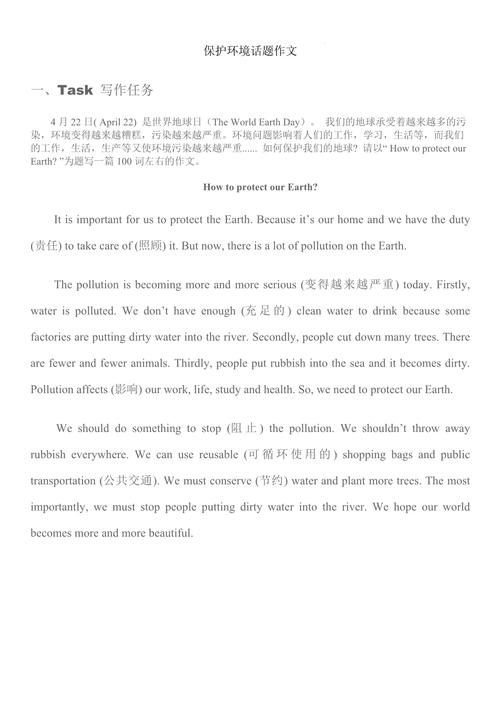
One of the biggest problems is pollution. Factories put dirty smoke into the air, and cars also make the air dirty. Our rivers and lakes are polluted by waste from factories and cities. The plastic we throw away stays in the environment for a very long time and hurts animals.
Another big problem is that we are cutting down too many trees. Trees are important because they give us oxygen and clean the air. Without them, the air becomes dirty, and many animals lose their homes.
We must act now to protect our environment. We can do many small things that make a big difference. For example, we should use less plastic. We can use reusable bags and bottles. We should also save electricity by turning off lights when we leave a room. Planting more trees is also a great way to help.
In conclusion, protecting the environment is everyone's job. Let's work together to make our planet a cleaner and healthier place for ourselves and for future generations.
标准版 (适合高中生或大学英语四级水平)
The Urgent Need for Environmental Protection**
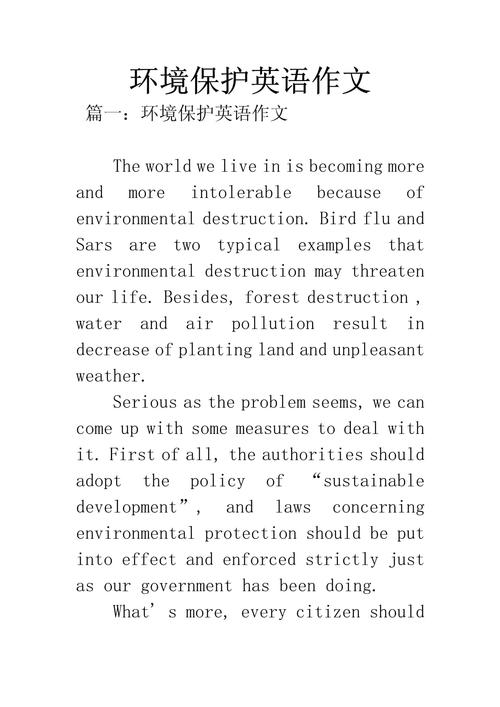
In the 21st century, humanity stands at a crossroads where our actions will determine the future of our planet. Environmental protection has evolved from a mere choice to an urgent necessity. The escalating crisis, marked by climate change, pollution, and biodiversity loss, demands immediate and collective action.
The most pressing issue is undoubtedly climate change, largely driven by the emission of greenhouse gases from burning fossil fuels. This has led to rising global temperatures, melting ice caps, and extreme weather events like hurricanes and droughts, which threaten communities and ecosystems worldwide. Alongside this, pollution in its various forms—air, water, and land—continues to degrade our quality of life. Toxic chemicals contaminate our water sources, while plastic waste clogs our oceans, endangering marine life and entering the food chain. Furthermore, the rampant deforestation of rainforests, often referred to as the "lungs of the Earth," not only destroys habitats for countless species but also reduces the planet's capacity to absorb carbon dioxide.
Addressing these challenges requires a multi-faceted approach. On a governmental level, stricter regulations must be enforced on industrial emissions and waste management. Investment in renewable energy sources such as solar, wind, and hydroelectric power should be prioritized to reduce our reliance on fossil fuels. On an individual level, we can contribute significantly by adopting a more sustainable lifestyle. This includes practicing the three R's: Reduce, Reuse, and Recycle. We can also opt for public transportation, conserve water and electricity, and support eco-friendly products.
In conclusion, the health of our environment is inextricably linked to our own well-being and survival. The time for passive concern is over; it is time for proactive engagement. By working together—from world leaders to every single citizen—we can forge a path towards a sustainable and prosperous future for all.
进阶版 (适合大学英语六级或雅思/托福水平)
Charting a Course for a Sustainable Future: An Imperative for Global Stewardship**
The Anthropocene epoch is defined by humanity's profound and often detrimental impact on the Earth's ecosystems. We are witnesses to an unprecedented environmental degradation, characterized by a complex interplay of climate instability, pervasive pollution, and mass extinction. This is not merely a scientific concern but a moral imperative, challenging our global capacity for stewardship and foresight.
The specter of climate change, fueled by anthropogenic greenhouse gas emissions, casts a long shadow over our collective future. The resultant global warming is not a distant threat but a present reality, manifesting in rising sea levels that inundate coastal cities, in more frequent and intense extreme weather events that displace millions, and in disruptions to agricultural systems that threaten global food security. Concurrently, the crisis of pollution has reached a critical point. From the microplastics infiltrating the deepest ocean trenches to the toxic algal blooms in freshwater lakes, our anthropogenic waste is poisoning the very systems that sustain life. The accelerating rate of deforestation, particularly in vital biomes like the Amazon and Congo basins, not only releases vast carbon stores but also irreplaceably erodes biodiversity, weakening the planet's ecological resilience.
Mitigating this multifaceted crisis demands a paradigm shift in our economic and social models. It necessitates a transition from a linear "take-make-dispose" economy to a circular economy that prioritizes resource efficiency and waste minimization. Governments must enact bold policies, including carbon pricing, stringent emissions standards, and the large-scale subsidization of green technologies. Corporations, as key economic actors, must integrate Environmental, Social, and Governance (ESG) principles into their core strategies, moving beyond superficial corporate social responsibility to genuine accountability. At the individual level, while systemic change is paramount, our choices hold power. Embracing a minimalist lifestyle, reducing one's carbon footprint through conscious consumption, and advocating for political change are all crucial components of the solution.
Ultimately, the quest for environmental protection is a quest for our own survival and a testament to our values. It is a call to move beyond short-term interests and embrace the profound responsibility we hold as temporary inhabitants of this planet. The path forward is fraught with challenges, but it is a path we must walk together, with wisdom, courage, and an unwavering commitment to safeguarding the Earth for generations to come.
核心词汇与短语
动词:
- Protect / Safeguard: 保护
- Preserve: 保存,保护 (尤指自然景观)
- Conserve: 节约,保护 (资源)
- Pollute: 污染
- Degrade: 使...退化,使...降级
- Deplete: 耗尽,使...枯竭
- Mitigate: 减轻,缓和
- Alleviate: 缓解,减轻
- Address / Tackle: 处理,应对
- Implement / Enforce: 实施,执行 (政策、法规)
- Advocate for: 倡导,主张
- Foster / Promote: 促进,培养
名词:
- Environment / Ecosystem: 环境 / 生态系统
- Pollution: 污染 (air, water, noise, light pollution)
- Climate Change / Global Warming: 气候变化 / 全球变暖
- Greenhouse Gases: 温室气体
- Biodiversity: 生物多样性
- Sustainability / Sustainable Development: 可持续性 / 可持续发展
- Renewable Energy: 可再生能源 (solar, wind, hydro power)
- Natural Resources: 自然资源
- Deforestation: 森林砍伐
- Recycling / Upcycling: 回收利用 / 升级改造
- Carbon Footprint: 碳足迹
- Stewardship: 管理职责,守护
形容词:
- Environmental / Ecological: 环境的 / 生态的
- Sustainable: 可持续的
- Renewable: 可再生的
- Non-renewable: 不可再生的
- Biodegradable: 可生物降解的
- Endangered: 濒危的
- Vital / Essential: 至关重要的
- Urgent / Pressing: 紧迫的
- Devastating / Destructive: 破坏性的
- Proactive / Reactive: 主动的 / 被动的
常用短语:
- Raise awareness: 提高意识
- Take measures/steps to do sth:采取措施做某事
- Play a vital/crucial role in...: 在...中扮演至关重要的角色
- Be responsible for...: 对...负责
- Give rise to / Lead to...: 导致,引起
- In the long run / In the short term: 从长远来看 / 从短期来看
- It is high time that we did sth. (虚拟语气): 是我们做某事的时候了。
- There is no doubt that...: 毫无疑问...
- Only by... can we...: 只有通过...我们才能...
写作技巧与建议
- 结构清晰: 采用“总-分-总”的经典结构,开头引出话题,中间段落分析问题、原因和解决方案,结尾总结观点并升华主题。
- 观点明确: 在开头或结尾清晰地表明你的立场或核心论点。
- 论据充分: 使用具体的例子来支撑你的观点,例如提到“太平洋垃圾带”或“巴黎气候协定”等,会让文章更有说服力。
- 逻辑连贯: 多使用连接词和过渡词,如
Firstly,Secondly,Furthermore,However,Therefore,In conclusion等,使文章逻辑流畅。 - 语言多样: 避免重复使用简单的词汇和句型,尝试使用更高级的词汇和复杂的句式(如定语从句、状语从句、倒装句等),但要注意准确性和自然度。
- 提出解决方案: 环境保护类作文不仅要指出问题,更要提出可行的解决方案,可以从个人、企业、政府等多个层面展开。
- 结尾升华: 结尾部分可以展望未来,呼吁行动,或强调保护环境对人类未来的重要性,给读者留下深刻印象。